Nomini

Dragon Tiger: Rules, Demo Play and Live Casino Explained

Last updated: January 2026 · Reviewed by the Casino and Betting India editorial desk

«Before you deposit, check the withdrawal rules and understand the house odds. Dragon Tiger is one of the fastest casino games available, but clarity on rules and terms must always come before placing real stakes.» Nisha Rao, Content Editor at Casino and Betting India (editorial persona)

Provider

Pragmatic Play

RTP

96.27%

Volatility

High

Min bet

$0.10

Max bet

$5,000

Max win

50:1

Dragon Tiger Rules, Demo Play and
Table of ContentCloseOpen
Four things to know before you

Four things to know before you play

  • Speed:A full Dragon Tiger round resolves in roughly 15-25 seconds, faster than baccarat or European roulette. That also means a bankroll can drain faster than you expect.
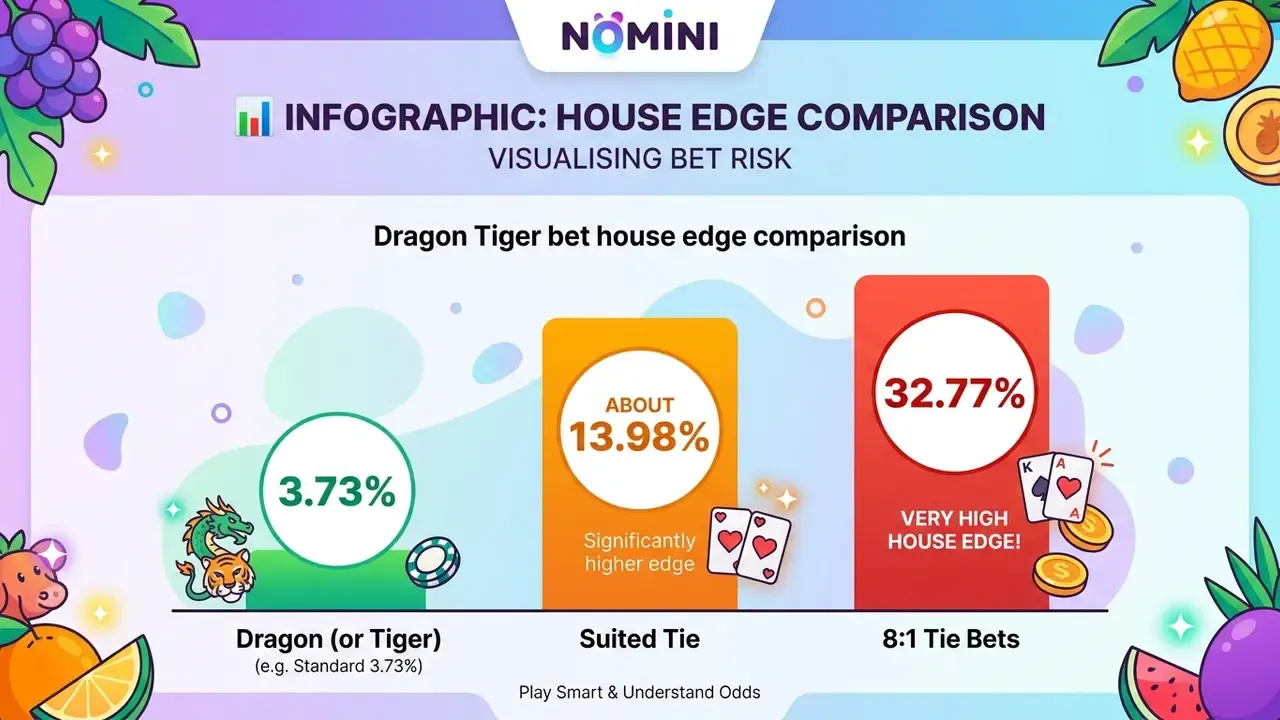
  • Maths:The main Dragon and Tiger bets carry a house edge of 3.73% (96.27% RTP) when half the stake is returned on a Tie.
  • Avoid the trap bets:An 8:1 Tie payout pushes the house edge to 32.77%; a Suited Tie at 50:1 sits near 13.98%. The main bets remain the mathematically sound choice.
  • Check the fine print:Table games often contribute only 0-10% toward bonus wagering, and Indian players must also account for the 28% GST charged on deposits and chip purchases at regulated casinos.

Short version? Learn the rules first, test them for free, and only then decide whether real money belongs in the picture at all.

What is Dragon Tiger and how

What is Dragon Tiger and how the game differs from other casino games

Dragon Tiger is a fast two-card comparison casino game that originated in Cambodia. One card goes to the Dragon position, one to the Tiger position, and the higher card wins the round. Unlike multi-card table options, this casino game removes complex drawing rules, hand combinations and post-deal player decisions. The core mechanic is simply the comparison of two single cards, which makes the game unusually easy to grasp for beginners while keeping a rapid pace for experienced players. Cards come from a shoe of 6 to 8 pre-shuffled standard decks, and every seated player has their own Dragon, Tiger and Tie betting boxes, because the game is always played against the dealer, never against the other participants at the table.

Dragon and Tiger the two sides

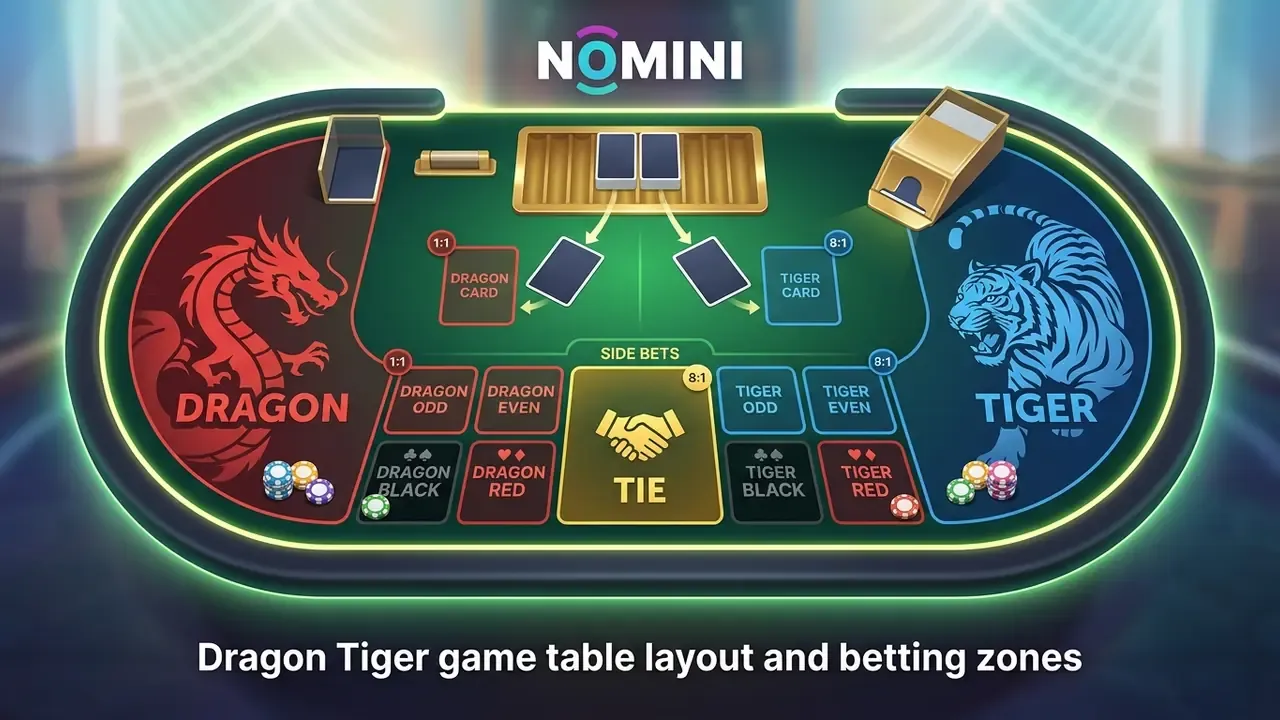
Dragon and Tiger: the two sides of the game table

The Dragon and Tiger positions are two symmetrical betting sides on the felt, and the player simply picks the side whose single card should rank higher. Card ranking follows plain high-card logic: Ace is lowest (counted as 1), then 2 through 10, then Jack, Queen and King as the highest at 13. Suits do not affect the main outcome, so a 9 of Spades against a 9 of Hearts is a Tie regardless of suit order. According to official rules published by the Gambling Regulatory Authority of Singapore (2024), the dealer draws one card for Dragon and one card for Tiger straight from the shoe, and the main wager settles instantly on rank comparison. Where suit order does matter, inside Suited Tie side bets, regulated rule sets rank the suits spades, hearts, clubs, then diamonds.

Some official layouts go beyond the three core boxes and add zones such as Big Dragon, Small Dragon, Big Tiger and Small Tiger. Study the felt, or the digital interface, before committing a single chip. Interfaces differ more than the rules do.


How Dragon Tiger differs from slot

How Dragon Tiger differs from slot and wheel games

Slot machines rely on multi-symbol payout matrices; wheel games rely on numbered segments and a spin. Dragon Tiger does neither. It is a fixed two-card comparison game with transparent odds and one meaningful player decision, taken before the deal. In slots, outcomes come from certified random number generator (RNG) paytables, and the player controls nothing after pressing spin, not volatility, not reel events, nothing. In wheel games, bets are locked before a physical or digital wheel stops. Dragon Tiger compresses the whole round into a binary choice between two cards, with an average round speed of 15 to 25 seconds, noticeably faster than baccarat or European roulette.

«Interactive slots generated roughly USD 1.07 billion in Pennsylvania during FY 2022/2023, while table games produced about USD 428 million, a 22.6% year-on-year increase.» Pennsylvania Gaming Control Board Annual Report, FY 2022/2023. https://www.pgcb.pa.gov

That regulator data shows the structural

That regulator data shows the structural picture. Slots still dominate revenue, yet the table-game segment, the category Dragon Tiger belongs to, is growing faster. It explains why operators keep pushing new two-card variants into their live lobbies, often with fresh side bets attached.

While preparing India-facing casino reviews, our editorial team walked through the onboarding flows and help centres of 15 online operators to see how each one explains table-game settlement. The qualitative observation was consistent. Platforms that opened with a plain two-card comparison explainer produced far fewer ambiguous "why was my bet not settled?" moments than those that dropped beginners straight into multi-card baccarat with third-card drawing rules.

To be precise, this is an internal editorial observation, not a measured statistic, so read it as directional; session-level proof would need operator telemetry we do not have. The practical takeaway still holds. When the structure is clear, a player can evaluate payouts and odds before money is at stake.

Dragon Tiger rules how a round

Dragon Tiger rules: how a round runs and how the result is determined

Standard dragon tiger rules ask the player to back Dragon, Tiger or Tie inside a short betting window, after which the dealer reveals one face-up card for each side. The higher-ranked card wins, and the winning main bet pays 1:1. If both cards share the exact same rank, the round is a Tie. Under no-commission rule sets, such as those documented in the Loto-Québec Dragon Tiger Rules (2025), a Tie pays 11:1 on the Tie wager and returns 50% of the main Dragon or Tiger stake to the player. Land-based Indian casino rule cards describe the same commission logic a little differently, half the main stake back plus a Tie payout somewhere between 8:1 and 11:1, so the exact number has to be read from the table you actually join.

«Cards in live dealer games must be fully visible to players, and every round must be reproducible for audit purposes.» Connecticut Department of Consumer Protection, Live Online Dealer Gaming Technical Specifications, 2024/2025. https://portal.ct.gov/DCP/Gaming-Division

The gap between commission and no-commission tables matters more than most beginners assume. On a no-commission table, a Tie returns half of your main stake, so a ₹1,000 bet on Dragon loses ₹500 on a Tie instead of the full amount. On tables that take a flat commission from winning main bets, the same nominal 1:1 payout quietly returns less than even money over time. Confirm which model applies before you size your unit bet, not after the third round.

The player's sequence of actions in

The player's sequence of actions in Dragon Tiger

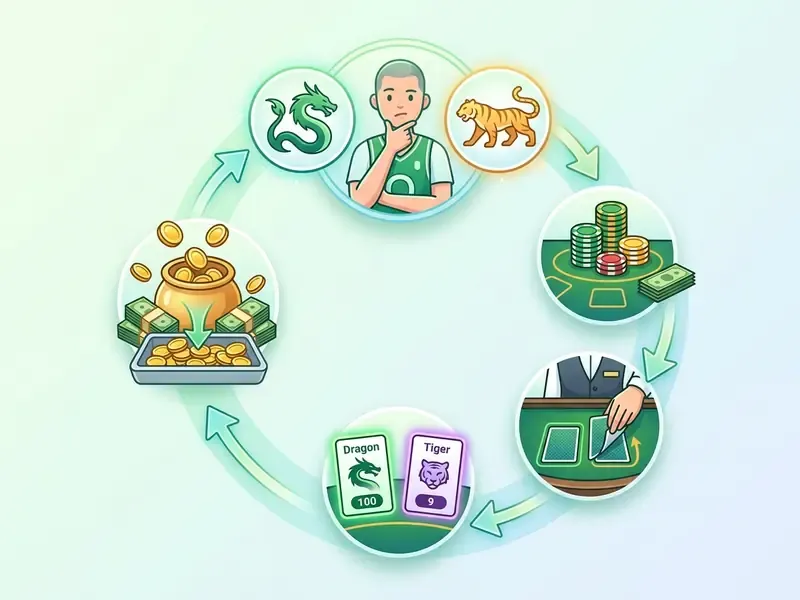
A standard round follows five steps, from the opening bell to settlement:

  1. Betting window opens: The dealer or the game interface signals that bets are open and shows a timer, usually 10 to 15 seconds.
  2. Placing the wager: The player picks a chip value and backs Dragon, Tiger, Tie, or one of the available side bets.
  3. Card dealing: The dealer draws two cards face-up from the shoe, the first to the Dragon box, the second to the Tiger box.
  4. Rank comparison: The live dealer or the software compares the numerical rank of both cards (Ace = 1, King = 13).
  5. Payout settlement: Winning Dragon or Tiger bets pay 1:1. If ranks match, Tie bets pay 11:1 (or 8:1, depending on operator rules) and half of the main Dragon or Tiger bet comes back.
Which game features to verify before

Which game features to verify before you bet

Before any real-money bet, check the payout conditions, side bet rules and table parameters. These game features change from provider to provider:
  • Tie payout ratios:Verify whether the platform pays 11:1 or 8:1 on a Tie, because 8:1 pushes the house edge dramatically higher.
  • Side bet availability:Check whether the variant includes Big/Small (Big wins on 8+, Small on 6 and below, and a 7 loses both) or Odd/Even options.
  • Suited Tie terms:Certain live provider variants offer a Suited Tie side bet paying up to 50:1 when rank and suit both match.
  • Outcome history (roadmaps):Look for scoreboards showing past results, and remember that every round stays an independent mathematical event.

«More than one third of Pennsylvania's online gamblers, over 33%, displayed at least one indicator of problem gambling, including chasing losses.» Pennsylvania DDAP Interactive Gaming Assessment 2023, Penn State University. https://www.ddap.pa.gov

Disclaimer: this information is general in nature and does not replace professional advice. Real-money gambling carries financial risk.

Side bets in detail, read the payout table before you commit:

Nomini heading-banner
  • Suited Tie side bet (50:1):Wins only when the Dragon and Tiger cards share the exact same rank and the identical suit, for example two 8 of Spades. The house edge on a 50:1 Suited Tie reaches roughly 13.98%, so it is a high-volatility option next to the 1:1 main bets. Some provider pages even market the game under the name "Suited Tie" because of it.
  • Big/Small and Odd/Even side bets:Big wins on cards ranked 8 through 13 (King); Small wins on cards ranked 1 through 6 (Ace to 6). Odd covers A, 3, 5, 9, J, K; Even covers 2, 4, 6, 8, 10, Q. Critical rule: if a 7 lands on the selected position, all Big, Small, Odd and Even wagers lose automatically.
  • Suit and colour bets:A minority of official variants add Red/Black (1:1) and single-suit bets (around 3:1). Lightning-style variants instead assign random suit multipliers before the deal, raising volatility without touching the underlying card mechanics.
How to read the scoreboards roadmaps

How to read the scoreboards (roadmaps)

Live and RNG interfaces both display outcome history through standardised "roads". They record what already happened. They predict nothing.
  • Bead Plate:Shows exact historical outcomes in a grid, filled column by column (Red = Dragon win, Blue = Tiger win, Green = Tie).
  • Big Road:Tracks consecutive streaks by opening a new column whenever the result alternates between Dragon and Tiger, which makes streaks and choppy sequences visually obvious.
  • Statistics panel:Shows the percentage split between Dragon, Tiger and Tie for the current shoe, plus per-suit frequencies in Lightning-style variants.

A quick warning from experience: roadmaps feel like insight. They are decoration for the maths, nothing more.

Dragon Tiger demo how to play

Dragon Tiger demo: how to play free before choosing a mode

Dragon Tiger demo mode is a free-play environment funded by virtual credits, and it lets you test rules, round speed, side bets and interface behaviour with zero financial exposure. A demo version mirrors the same probability matrix and card distribution as RNG real-money tables, which makes it a sensible testing ground for beginners still comparing online casino lobbies and providers.

[💬 QUOTE: "Testing a casino game in demo mode allows you to master the interface, understand the round speed, and verify side-bet rules before putting any real bankroll on the line." Nisha Rao]

Virtual demo credits hold no monetary value. Demo winnings cannot be converted into cash or withdrawn to a bank account, and no bonus is attached to them either. Demo modes are widely available for RNG software tables, while live dealer streams rarely allow free betting, mostly because streaming bandwidth costs money. Some platforms do let registered users enter a live dealer room in spectator mode and watch rounds without staking anything.

Advanced RNG demo features worth testing. Modern First Person style builds give structural controls no live stream can match:

Nomini heading-banner
  • Shuffle Shoe control:Reset and shuffle the eight-deck virtual shoe whenever you want, which resets the statistical distribution and gives you a clean roadmap on demand.
  • Free Hand dealing:Deal consecutive test hands without an active wager, so you can generate and study roadmaps (Bead Plate, Big Road) before committing credits.
  • Pace control:The round starts when you press deal, so you set the tempo instead of chasing a 10-15 second dealer timer. Handy when you want to read side-bet rules line by line.
  • "Go Live" portal integration:A direct in-interface entry point that moves the player from the RNG table into the matching live-dealer table, carrying the same interface conventions and side-bet set across.

Do you need to register or pass KYC to use demo mode? Usually no. Provider showcase pages and casino "fun play" tabs open after a simple age confirmation. Registration and full KYC become mandatory only when you switch to real-money play, deposit funds or request a withdrawal. That single line saves a lot of confusion for first-time users in India, where verification questions come up early.

Dragon Tiger live dealer: features of the live casino game

Dragon Tiger live dealer pairs real-time HD video of a human dealer with a physical card shoe, bringing something close to a casino floor onto desktop and mobile screens. Tables hosted by suppliers such as Evolution, Pragmatic Play and BETER run from dedicated studios, where Optical Character Recognition (OCR) technology scans the physical cards into the digital betting interface within a second.

«Live dealer platforms must provide deterministic server-side logic, synchronised wagering and a complete audit trail for every round.» Connecticut Department of Consumer Protection, Live Online Dealer Gaming Technical Specifications, 2024/2025. https://portal.ct.gov/DCP/Gaming-Division

AspectDragon Tiger DemoDragon Tiger Live Dealer
Mode of playSoftware RNG simulation with virtual creditsReal-time HD video stream with physical cards
Dealer presenceAutomated digital interfaceProfessional live human dealer
Financial riskZero financial exposure (play money)Real-money wagering (INR and localised options)
Side bets and featuresStandard digital options, plus Shuffle Shoe and Free Hand dealingMultipliers (Lightning modes), chat, live roadmaps
Pacing controlPlayer initiates the round, tempo fully player-controlledFixed dealer-led timer, 10-15 second betting window
Shoe managementManual shuffle button available at any timeDealer-managed 6-8 deck shoe with scheduled shuffles
Audit and transparencyCertified RNG logsRegulator-mandated round reproducibility and full card visibility
Primary goalPractice the rules and check the interfaceReal-money entertainment and live interaction

In plain terms: demo teaches, dragon tiger live entertains, and only one of them can cost you money. Live tables usually add interactive chat, so players can speak to the host and follow real-time statistics on screen. Some modern live variants introduce random suit multipliers up to 1280x, which stretches volatility well beyond the traditional 1:1 payout structure. Studios also localise the product. Leading suppliers advertise dealers in 35+ languages and adjustable bet limits, which is why Hindi-speaking tables and low-stake INR tables now show up in most India-facing lobbies.

Dragon Tiger real money what to

Dragon Tiger real money: what to check before playing for cash

Disclaimer: this information is general in nature and does not replace professional advice. Real-money play carries financial risk. Set limits in advance and seek help at the first signs of problem gambling.

Playing Dragon Tiger real money means dealing with three unglamorous things first: bankroll management, payment options (UPI, NetBanking, INR support), and a written loss limit. Rounds finish in seconds, so quick repeated betting can empty a balance quickly when no boundaries exist. That speed is the main risk factor here, not the rules.

[⚠️ ALERT BOX: Responsible Gambling Notice
Real-money casino play carries inherent financial risk. Dragon Tiger is a game of chance with a fixed house edge; it is not a source of income or a method for financial gain. Always set strict daily deposit limits, use only discretionary funds, and never chase losses. Check the age and territorial conditions of the casino before registering. If gambling stops being entertainment, access self-exclusion tools immediately.]

For Indian players, payment friction and verification rules deserve attention before the first deposit, not after a payout request. Confirm that the platform accepts local currency (INR) and supports reliable rails such as UPI or IMPS, and check the minimum withdrawal amount while you are there.

«Around 16% of Pennsylvania adults gambled online in the previous year, and players who combine online and land-based formats show higher rates of problem gambling.» Pennsylvania DDAP Online Gambling Report 2024, Penn State University. https://www.ddap.pa.gov

That finding supports one simple habit: pre-commit to a fixed session budget. Cap each bet at 1% to 2% of the session bankroll, write down a stop-loss before the first hand, and treat your profit target as a hard exit, not a polite suggestion. Regulatory codes in mature markets require operators to offer deposit and time limits for 24-hour, 7-day and 1-month periods. Use those tools at registration, while your judgement is calm, rather than in the middle of a losing run.

India regulatory and tax notice. Under

India regulatory and tax notice

Under Indian Ministry of Finance rules (Notification No. 51/2023, effective 1 October 2023), a 28% Goods and Services Tax (GST) applies to the amount paid for chips or playing coupons at regulated casinos, and this GST is not refunded when chips are returned or encashed. In practice, the tax lands upfront on the face value of your buy-in or deposit, not on winnings, so a ₹10,000 buy-in leaves you with materially less playing capital than the headline figure suggests. Adjust your unit-bet maths for that cost before you sit down, and separately check whether the operator applies withholding tax (TDS) on winnings at the withdrawal stage.

Legal status in India what a
Gambling law in India sits mainly with the states, layered on top of the colonial-era Public Gambling Act. The result is a patchwork, not one national rule:
  • Permissive states:Goa, Daman and Sikkim license land-based casinos, and Sikkim and Nagaland have operated their own online gaming licence frameworks.
  • Restrictive states:Andhra Pradesh, Telangana and several others amended their gaming acts to prohibit online games played for stakes, including bans reaching games marketed as games of skill.
  • Everywhere else:Enforcement, payment-rail availability and the position of offshore operators stay contested and can change quickly.

So confirm the current position in your own state before depositing. Prefer operators that publish verifiable licensing credentials, complete KYC honestly to avoid frozen withdrawals, and keep one thing in mind: a platform accepting UPI is not proof of legality. This article is informational and is not legal or tax advice; a qualified professional should review your specific situation.

How to access a Dragon Tiger casino and evaluate the offer

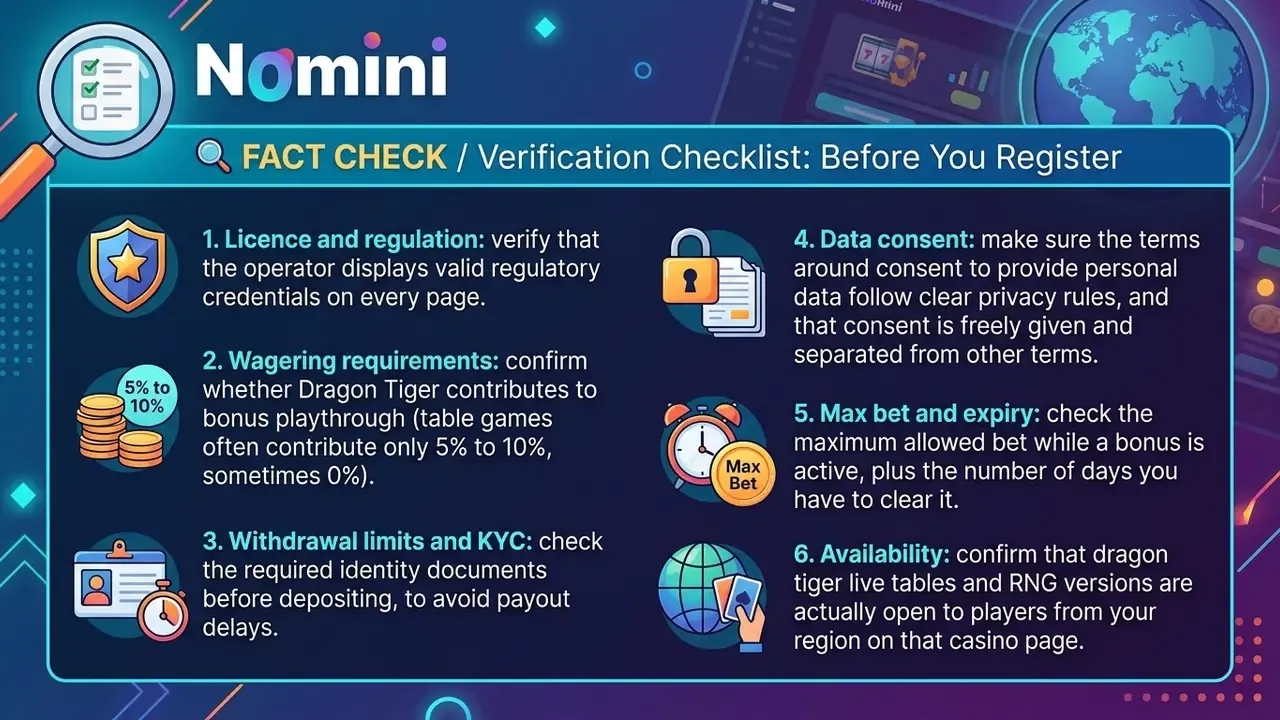
To reach Dragon Tiger online with less risk, start with a licensed operator that supports localised Indian payment methods, transparent KYC checks and readable promotional terms. When you assess a welcome offer or deposit bonus, read the mechanics underneath the headline number. That discipline applies across all iGaming platforms, not only casino verticals.

Regulatory guidance in mature markets is explicit on two points worth carrying into any offer review. Operators must obtain express and informed consent before enrolling a customer in a promotion, and winnings generated from a player's own deposited funds must stay withdrawable regardless of bonus playthrough. If the terms blur that line, treat it as a red flag and move on.

Worked example: why "30x" can really mean "300x".

InputValue
Deposit₹1,000
Bonus100% = ₹1,000
Stated wagering requirement30x bonus
Dragon Tiger contribution10%
Nominal turnover required 1,000 30 30,000

Nominal turnover required: ₹1,000 × 30 = ₹30,000. But with a 10% contribution, every ₹100 wagered counts as only ₹10 toward the requirement. Real turnover needed at the Dragon Tiger table: ₹30,000 ÷ 0.10 = ₹300,000, effectively a 300x requirement on the bonus. At a 3.73% house edge, the expected theoretical loss across that turnover is roughly ₹11,190, far more than the ₹1,000 bonus itself. If contribution is 0%, the bonus cannot be cleared at this table at all. No strategy fixes that.

During audit tests on promotional offers, our editorial team read the terms and conditions of 20 welcome bonuses aimed at Indian casino users, focusing on the game-contribution tables. The qualitative finding: most standard casino welcome bonuses either excluded live dealer table games from wagering contribution completely or capped them at a token percentage.

We publish this as an editorial review, not a statistically representative sample, since offer terms change often and vary by brand. Still, the pattern is stable enough to justify one rule. Read the contribution table before you register, not after you claim.

Dragon Tiger strategy: using the rules and demo mode to choose an approach

A workable dragon tiger strategy comes down to bankroll discipline and refusing high-house-edge side bets. The card comparison is mathematically fixed, so no skill element shifts long-term RTP. The main Dragon and Tiger wagers carry a house edge of 3.73% (RTP of 96.27%), assuming half the stake returns on a Tie.

House edge for Dragon/Tiger main bets (3
Betting the Tie is a different

Betting the Tie is a different story. Widely published probability analyses of the eight-deck shoe put an 8:1 Tie payout at a house edge of 32.77%, one of the weakest bets you will find anywhere on a casino floor. Even the friendlier 11:1 Tie stays far behind the main bets, and the 50:1 Suited Tie sits near 13.98%. Card counting exists for multi-deck shoe games, yet academic and industry analyses agree that this single-card format yields a negligible player edge, because shoes get reshuffled long before meaningful rank imbalances build up. Any theoretical counted edge would also demand a bankroll of roughly 200 to 300 betting units just to survive variance, which puts it outside recreational play entirely.

«Interactive table game revenue in Pennsylvania grew 23% in FY 2023/2024, reaching USD 525 million.» Pennsylvania Gaming Control Board Annual Report, FY 2023/2024. https://www.pgcb.pa.gov

A growing segment brings more variants

A growing segment brings more variants, more side bets and more marketing pressure, which is exactly why a personal rule set matters. Structurally, the sensible approach looks boring: stay on the main Dragon and Tiger bets, keep unit sizes fixed at 1% to 2% of the session bankroll, write your stop-loss and profit target before the first hand, and use dragon tiger demo play to internalise the pacing before real credits appear. Progressive staking, flat-betting tweaks and roadmap "trend following" leave the 3.73% edge exactly where it was. Only bet selection and session discipline sit inside your control. Boring, yes, but honest.

FAQ about Dragon Tiger online

Before you play: a short pre-deposit checklist

1
Read the Tie payout on your table, 11:1 or 8:1, and note whether commission applies.
2
Open the demo first, run 20 free hands, and confirm you can read the interface without hesitation.
3
Check the game-contribution table if any bonus is involved.
4
Set a deposit limit, a time limit and a stop-loss before your first real bet.
5
Confirm the legal position in your state, and complete KYC before, not after, a withdrawal request.
Responsible gambling notice: this article is informational and does not constitute legal, tax or financial advice. Gambling involves the risk of financial loss and offers no guaranteed winnings or income. Players must be of legal age in their jurisdiction. If gambling stops being entertainment, use deposit limits, time limits and self-exclusion tools, or contact a support service.