
"A big bonus or a fast-dealing table means very little if the withdrawal rules, licensing verification, and bankroll limits are not checked first. Baccarat remains one of the simplest card games in the casino ecosystem, but its simplicity often masks critical trade-offs between house edge, payout speed, and real-money payment friction." — Nisha Rao, Casino Content Editor at Casino and Betting India
Table of ContentCloseOpen
- TL;DR Quick Summary for Busy Readers
- Quick Rules Summary and Beginner Glossary
- What Is Online Baccarat and How the Game Works
- Baccarat Rules: Objective and Card Counting
- Baccarat Bets: Player, Banker and Tie
- Baccarat Variants: Punto Banco, Mini, Speed and Live Formats
- How to Access a Baccarat Casino and Assess Playing Conditions
- Baccarat Strategy: How to Bet Consciously
- Common Mistakes to Avoid
- FAQ
Online Baccarat: Rules, Bets, Demo Play and Real-Money Games
Last updated: February 2026 · Reviewed by: editorial desk of Casino and Betting India
Online baccarat is a card-comparison game where players bet on which of two hands, the Player or the Banker, will finish with a point total closest to 9, or whether the round will end in a Tie. Modern platforms present this classic casino baccarat title in two ways: software-driven random number generator (RNG) formats and real-time live dealer streams. The structural rules stay fixed in both. What changes is the wrapper, plus the choice between free demo practice and real-money stakes.
For Indian users comparing options, the useful questions are practical ones. How does baccarat behave on a phone versus a laptop? What are the real odds? Which payment rails, UPI, IMPS or NetBanking, actually work for withdrawals? And what safety tools does the platform give you before you deposit a rupee?
TL;DR Quick Summary for Busy Readers
- Goal of the game:bet on the hand (Player or Banker) that ends closest to 9 points. You make no decisions after the deal. Everything follows a fixed drawing table.
- Card values:Ace = 1; cards 2 to 9 = face value; 10, Jack, Queen, King = 0. Totals above 9 drop the tens digit (15 becomes 5).
- Best bet mathematically:Banker, house edge 1.06% (pays 0.95:1 after the 5% commission). Player, 1.24% (pays 1:1). Tie, 14.36% at 8:1, which is entertainment only.
- Side bets(Pairs, Perfect Pair, Super 6) look attractive but carry house edges of 10% to 14%+.
- Demo vs real money:demo uses virtual chips, resets on refresh, and never pays out. Real-money play requires KYC, a funded balance, and bankroll discipline.
- Before depositing:verify the licence register, RNG audit seals, UPI/IMPS/NetBanking withdrawal timelines, bonus game-weighting (baccarat often counts just 5% to 10% toward wagering), and responsible-gambling tools.
- No system beats the maths.Martingale, Paroli and Fibonacci only redistribute variance. Each hand is statistically independent of the last.
Quick Rules Summary and Beginner Glossary
Never opened a baccarat table before? These five lines are enough to start following the action:
- You place a bet on Player, Banker, or Tie before any card appears.
- Two cards go to the Player hand and two to the Banker hand.
- Totals are single digits: 7 + 8 = 15, so 5 points.
- A total of 8 or 9 on the first two cards is a natural, and the round ends immediately.
- If no natural appears, a third card may be dealt automatically. Nobody chooses. The rules decide.
| Term | Plain-English meaning |
|---|---|
| Punto Banco | The standard casino-banked version of baccarat played worldwide, including online. |
| Shoe | The container holding six or eight shuffled 52-card decks used for dealing. |
| Natural | A two-card total of 8 or 9, which ends the round without a third card. |
| Tableau | The fixed third-card drawing table that replaces player decisions. |
| House edge | The casino's long-run mathematical advantage, expressed as a percentage of each bet. |
| RTP | Return to player, the theoretical percentage returned over very long play (100% minus house edge). |
| Roadmap | On-screen scoreboards (Big Road, Bead Plate) showing past results. They have no predictive power. |
| Commission | The 5% fee deducted from winning Banker bets in standard baccarat. |
What Is Online Baccarat and How the Game Works
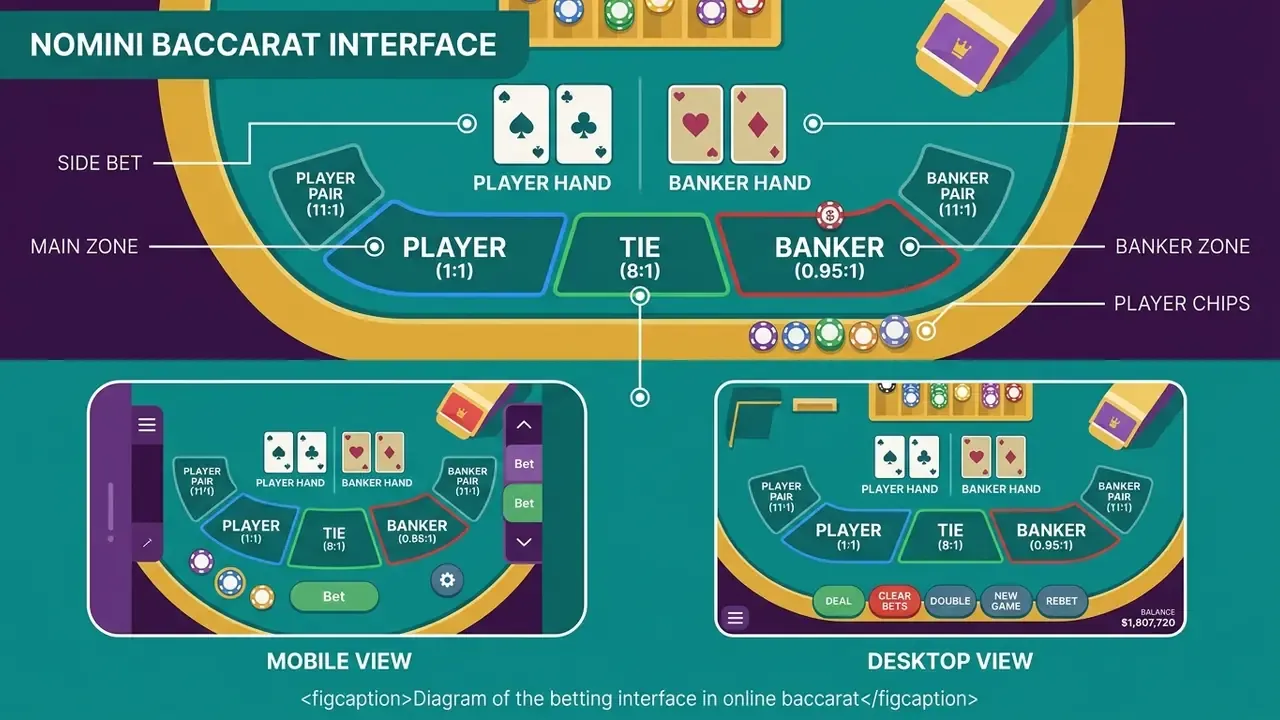
Online baccarat is a digital adaptation of the traditional casino card game, and players wager on one of three primary outcomes: Player win, Banker win, or Tie, all before any cards are dealt. The dealing process then follows a deterministic drawing matrix, which means players make no decisions after placing chips on the baccarat table. In practice, this makes baccarat one of the few casino games where "skill" is limited entirely to bet selection and money management.
Origins and culture: Baccarat traces back to 15th-century Italy and France, where chemin de fer and baccarat banque were played by aristocrats. The future King Edward VII was even entangled in a baccarat scandal in the late 1800s. The modern casino-banked form, Punto Banco, was popularised in 1950s Havana at the Capri Hotel & Casino under Francisco "Tommy" Renzoni, who carried the game to the Sands Hotel and Casino in Las Vegas after the Cuban Revolution, where Frank Sinatra's Rat Pack circle helped it take root. The game reached global pop-culture fame as James Bond's wager of choice in Ian Fleming's Casino Royale, cementing the tuxedo-and-high-limits image that live dealer studios still borrow today.
In standard casino baccarat, predominantly the Punto Banco format, the game uses six or eight standard 52-card decks. Suits carry no value at all. Hand totals are calculated with a single-digit modulo-10 system. When you compare games baccarat in digital environments, two delivery mechanisms exist: RNG software and live video streams. In software-based baccarat online, certified algorithms dictate card distribution.
«A simulation of one million eight-deck baccarat hands showed that empirical outcome frequencies match theoretical probabilities within ±0.05%.» — Effortless Math, Baccarat Probability Simulation (2023). https://effortlessmath.com
In live dealer formats, physical cards are dealt by a human dealer in a dedicated studio, with optical character recognition reading each card in real time. Rules, payouts and house edge stay identical across both delivery models. Only the dealing mechanism and the presentation change.
From an operational standpoint, our editorial desk reviewed the publicly documented lobbies, rule sheets and cashier pages of 14 India-facing online casino interfaces between 2024 and 2026, comparing how each platform handles the move from demo software to live tables. This was a qualitative interface review, not a statistically representative sample, so read the figures below as observations rather than market averages. We noticed that software games baccarat load instantly and accept flexible stake entry, while live dealer tables demand funded accounts, completed verification, and stable bandwidth for high-definition video.
Baccarat Demo vs Real-Money Play
Baccarat demo is a free-play mode that uses virtual credits to simulate gameplay. It lets you learn the baccarat rules, test UI layouts, and watch dealing speed without financial exposure. Baccarat real money play, by contrast, requires account registration, identity verification, and deposited funds. That unlocks cash payouts and, honestly, real account risk too.
Demo play is an ideal sandbox for watching the third-card tableau operate live. Virtual balances reset when you refresh the browser, though, and demo modes do not support withdrawals, promotional clearing, or live chat. Live dealer tables are usually excluded from demo access altogether, because streamed rounds share betting positions with real-money participants.
Moving from free baccarat play to real-money wagering means weighing deposit friction, KYC requirements, and your own budget limits.
How to open a demo table without registering (checklist):
- Open the casino's game lobby and filter by Table Games → Baccarat.
- Look for a "Demo", "Play for Fun" or "Try Free" label on the game tile. RNG titles usually offer it; live tables usually do not.
- Launch the game and confirm the balance shows virtual credits (often 1,000 to 5,000 units) rather than INR.
- Check whether the demo exposes the same rule sheet, side bets and table limits as the cash version. Differences are common.
- Note that some licensed jurisdictions require an account login even for free play, in line with responsible-gambling standards that keep minors and self-excluded users away from demo games.
Baccarat Live Dealer, First Person Baccarat and Table Controls
Baccarat live dealer games stream a real human dealer working at a physical table. First Person Baccarat uses 3D RNG graphics with a built-in option to switch straight to a live table. Both formats preserve identical hand scoring, house edge values, and core baccarat strategy logic.
«The global live dealer market exceeded USD 12 billion in 2024, and 73% of online players under 35 prefer live tables to RNG versions.» — Live Dealer Casino Industry Trend Analysis (2024). https://nomini-india.com

In a baccarat live casino setting, optical camera technology reads physical cards instantly and overlays digital result indicators on your screen. Formats such as First Person Baccarat from Evolution Gaming bridge software and live environments. They feature an authentic virtual "Baccarat Hall" interface, table-sorting filters, shoe-shuffle and free-hand options, and a dedicated "GO LIVE" button that redirects you to a live stream while preserving your settings. Published RTP values for the format sit at 98.94% on Evolution's own listings, with some operator configurations showing 98.76%. Read the in-game rule sheet, not a marketing tile.
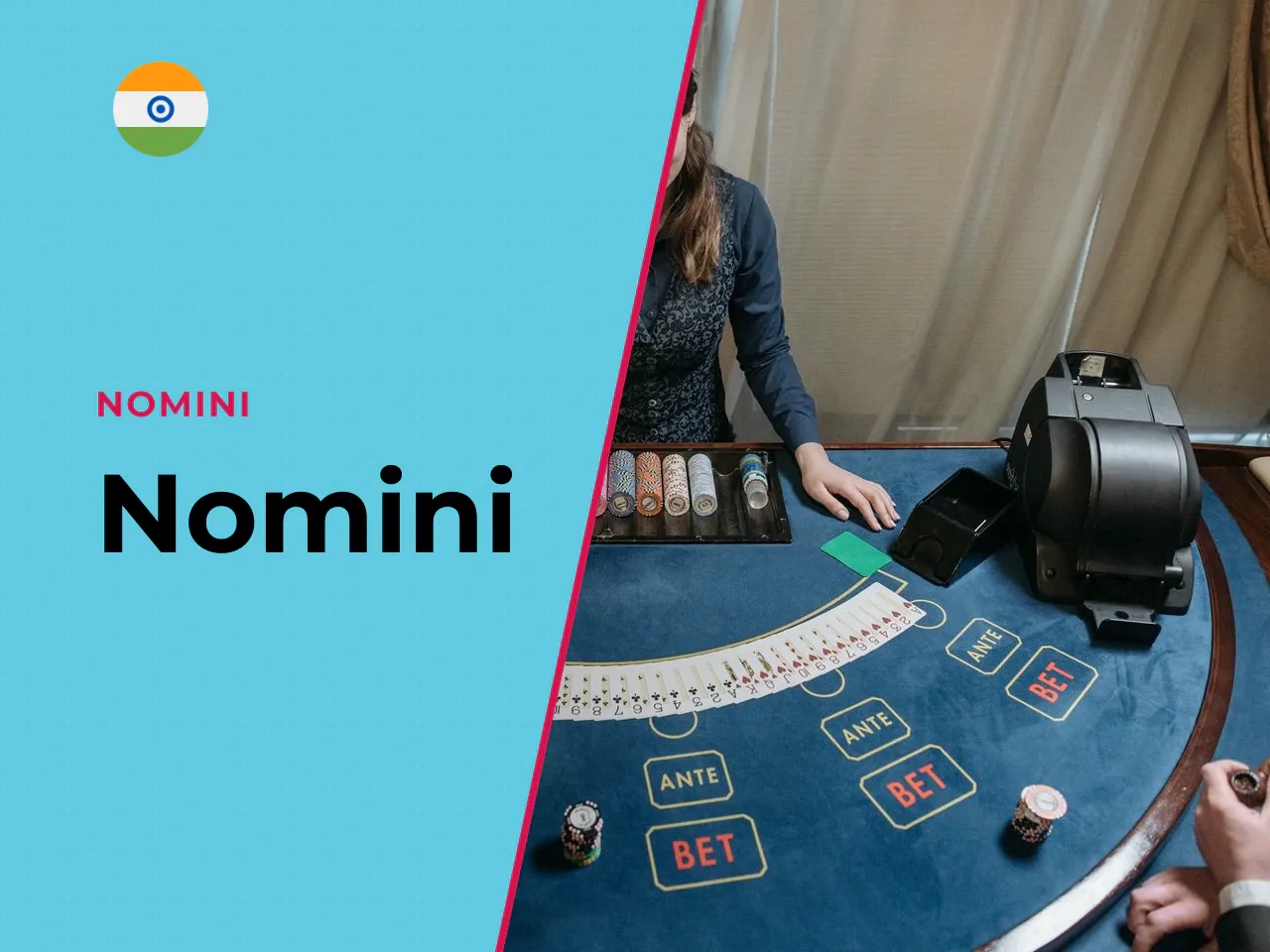
Live table controls you should recognise before your first hand:
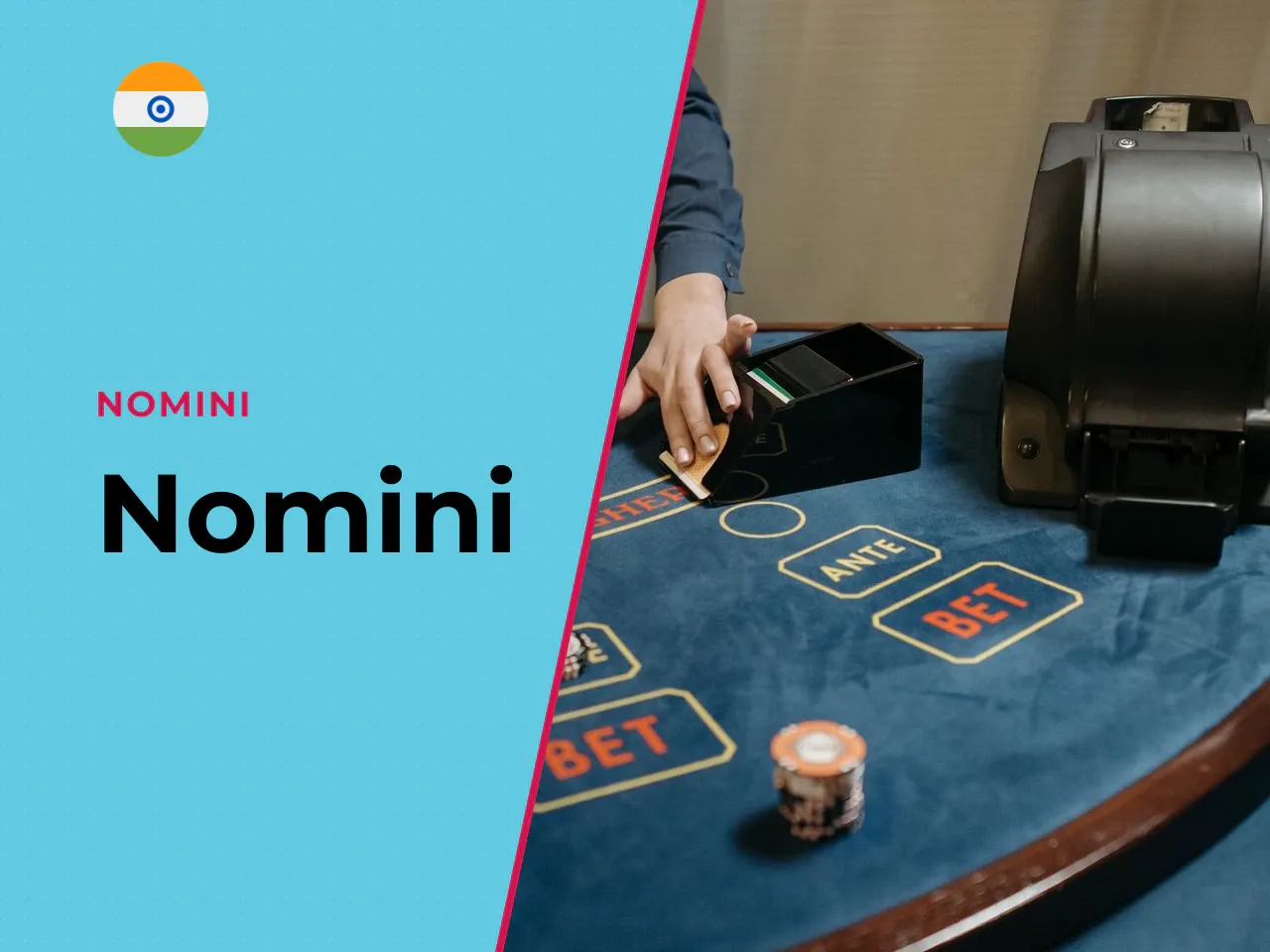
- Betting status indicators ("traffic lights"):Green means betting open; Yellow means the window is closing; Red means bets closed. Minimising the browser or switching tabs during the green phase can get your bet declined.
- Chip tray and stake stacking:pick a chip denomination, then click a betting spot. Clicking again adds another chip, or use Double to duplicate the previous stake.
- Re-bet button:repeats your whole previous layout in one click. Convenient, yes, and it also accelerates spend, so use it deliberately.
- Roadmaps and shoe statistics:Big Road, Bead Plate, Big Eye Boy and Cockroach Pig scoreboards track patterns inside the current six- or eight-deck shoe. Historical records only. Zero predictive power.
- Chat interface:text communication with the croupier and, on some tables, other players. Dealers cannot advise on bets.
- Round timer:classic live baccarat rounds run roughly 45 to 48 seconds, while Speed Baccarat compresses a full round into about 27 seconds.
- Video quality selector:lowering stream quality preserves stability on mobile data, which matters a lot for players on 4G connections in India.
For a like-for-like comparison of studios, table limits and certified RTP tables across operators available to Indian users, see our live casino review hub.
Baccarat Rules: Objective and Card Counting
The objective in a baccarat game is to bet on the hand that finishes closest to 9 points. Point totals are computed by adding card values and dropping the tens digit whenever a total reaches 10 or higher. Unlike blackjack, no hand can "bust". The scoring range is permanently 0 to 9.
To calculate any baccarat hand value, card values follow strict, non-negotiable definitions used across global casino standards (Loto-Québec Baccarat Rules, 2023):

- Aces:count as 1 point.
- Cards 2 through 9:retain face value (a 7 is worth 7 points).
- 10, Jack, Queen, King:count as 0 points.
When a hand total reaches 10 or more, only the rightmost digit forms the final value. A hand of 7 and 8 totals 15, which becomes a 5-point hand ($15 - 10 = 5$). A King (0) with a 9 equals a natural 9.
| Card Rank / Combination | Numeric Value in Baccarat | Computation Example |
|---|---|---|
| Ace | 1 point | Ace + 8 = 9 points (Natural) |
| 2 – 9 | Face value (2 to 9) | 7 + 9 = 16 $\rightarrow$ 6 points |
| 10, Jack, Queen, King | 0 points | King + 10 + 4 = 14 $\rightarrow$ 4 points |
| Three-Card Hand (e.g., 5, 9, 8) | Sum modulo 10 | $5 + 9 + 8 = 22 \rightarrow$ 2 points |
If the Player or the Banker receives an initial two-card total of 8 or 9, that is a "natural". The round ends immediately and no further cards are dealt to either hand.
How the Winner Is Determined Between Player and Banker
The winning hand is the one that finishes closer to 9 after all required cards are dealt. If both hands end on identical point values, the round is a Tie: active Player and Banker bets push, while winning Tie wagers pay out.
A Player hand of 7 against a Banker hand of 6 wins and pays even money (1:1). If the Banker holds 8 and the Player holds 5, the Banker takes it. When both sides land on the same total, say 6 to 6, neither main bet loses. Your original stake stays intact and comes back to you.
When a Third Card Is Dealt (the Tableau)
A third card is dealt automatically according to a fixed drawing matrix, the Tableau, which evaluates the Player hand's two-card total first and then the Banker's. Neither the dealer nor the player has any discretion here.
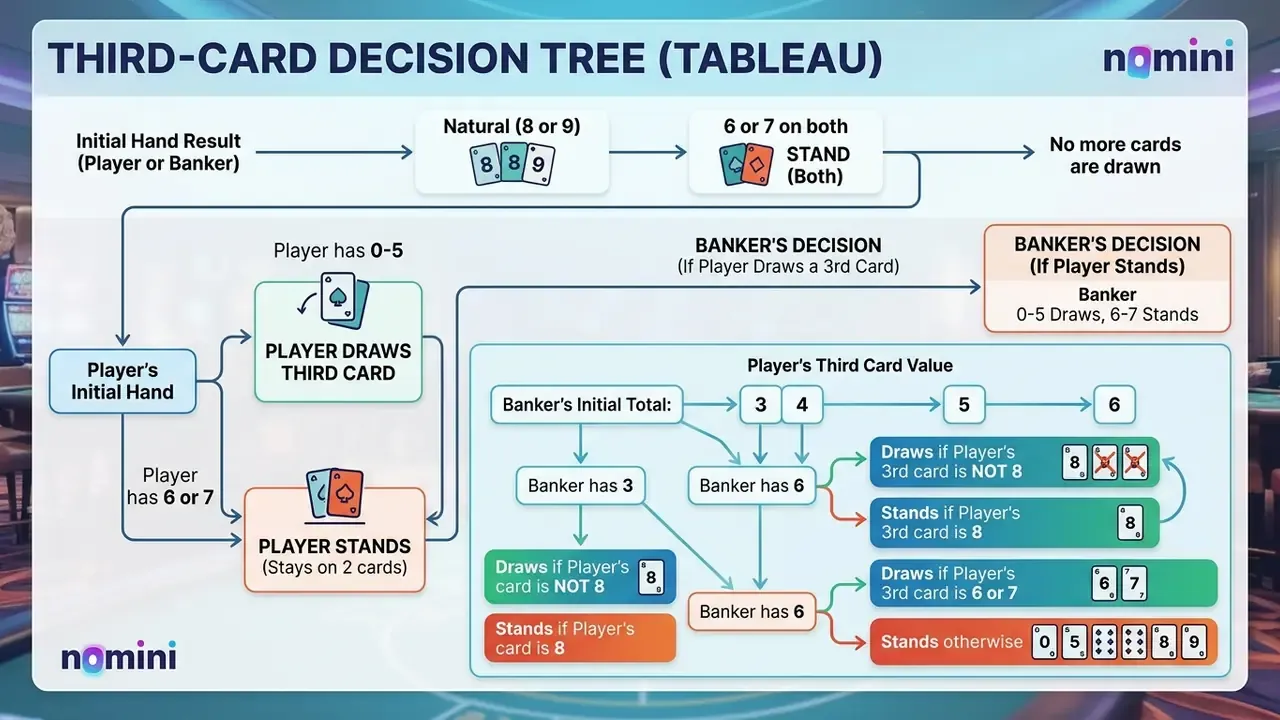
Player hand, the simple half of the rule:
| Player's first two cards | Action |
|---|---|
| 0 – 5 | Draws a third card |
| 6 – 7 | Stands |
| 8 – 9 | Natural, round ends immediately |
Banker hand, which depends on the Player's third card:
| Banker total | Draws when Player's third card is… | Stands when Player's third card is… |
|---|---|---|
| 0 – 2 | Any card (always draws) | — |
| 3 | 1, 2, 3, 4, 5, 6, 7, 9, 10/J/Q/K | 8 |
| 4 | 2, 3, 4, 5, 6, 7 | 1, 8, 9, 10/J/Q/K |
| 5 | 4, 5, 6, 7 | 1, 2, 3, 8, 9, 10/J/Q/K |
| 6 | 6, 7 | All other cards |
| 7 | — | Always stands |
| 8 – 9 | Natural, round ends immediately | — |
If the Player stood on 6 or 7 with no third card, the Banker follows a simplified rule: draw on 0 to 5, stand on 6 to 7.
The drawing sequence therefore follows standard regulatory rules:
- Player Rule: with an initial two-card total of 0 to 5, the Player hand draws a third card. On 6 or 7, the Player stands.
- Banker Rule: if the Player stood, the Banker draws on 0 to 5 and stands on 6 to 7. If the Player drew, the Banker acts on its own total and the exact value of the Player's third card:
- Banker total 0–2:always draws.
- Banker total 3:draws unless the Player's third card was an 8.
- Banker total 4:draws if the Player's third card was 2 to 7.
- Banker total 5:draws if the Player's third card was 4 to 7.
- Banker total 6:draws if the Player's third card was 6 or 7.
- Banker total 7:always stands.
Baccarat Bets: Player, Banker and Tie
A baccarat table offers three core betting options: the Player hand, the Banker hand, or a Tie. Each wager carries its own winning conditions, payout odds, and statistical house edge.
| Bet Type | Win Condition | Standard Payout | Probability of Winning | House Edge (8 Decks) | Theoretical RTP |
|---|---|---|---|---|---|
| Player Bet | Player total > Banker total | 1 to 1 (Even Money) | $\approx 44.62%$ | $1.24%$ | $98.76%$ |
| Banker Bet | Banker total > Player total | 0.95 to 1 (1:1 minus 5% fee) | $\approx 45.86%$ | $1.06%$ | $98.94%$ |
| Tie Bet | Player total = Banker total | 8 to 1 (or 9 to 1) | $\approx 9.52%$ | $14.36%$ (at 8:1) | $85.64%$ |
Mathematical modelling across eight-deck shoes shows the Banker bet carries the lowest statistical house edge at 1.06%, even with the standard 5% commission on winning Banker hands.
«Combinatorial analysis of eight-deck baccarat confirms: the Banker wins ≈45.86% of hands, the Player ≈44.62%, and ties occur in ≈9.52% of rounds.» — Wizard of Odds, Baccarat House Edge Calculator / Combinatorial Analysis (2024). https://wizardofodds.com
Note that these percentages include ties. Strip the tie rounds out and the Banker wins about 50.68% of decided hands, which is precisely why the house charges commission on it.

The Player and Banker Bets in Detail
A Player bet pays 1:1 when the Player hand beats the Banker, with a house edge of 1.24%. A Banker bet pays 0.95:1 after the 5% commission and carries a lower edge of 1.06%.
The Banker hand holds a persistent positional advantage because its third-card rules depend on what the Player did. Over extended play the Banker wins roughly 45.86% of all hands against 44.62% for the Player.
In No Commission Baccarat variants, winning Banker hands pay 1:1 unless the Banker wins with a total of 6, where the payout drops to 0.5:1 (1 to 2). This keeps the house edge broadly comparable to standard commission baccarat while removing fractional payout maths.
Put differently, the operator shifts its take from a flat 5% fee on every Banker win to a reduced payout on one specific outcome. The advantage does not vanish. It just moves.
Practical stake example (₹1,000 wagered on Banker, standard rules): a win returns ₹950 profit rather than ₹1,000. Across 100 hands of ₹1,000, the theoretical long-run cost of the Banker bet is about ₹1,060, versus ₹1,240 on the Player bet and ₹14,360 on the Tie bet.

The Tie Bet and Its Real Cost
A Tie bet wins only when both hands finish on identical totals. It pays 8:1 (sometimes 9:1) but carries an exceptionally high house edge of 14.36% under standard rules.
Ties occur in roughly 9.52% of dealt hands, so less than once every ten rounds. An 8:1 payout looks tempting to casual players, yet the return to player falls to 85.64%. In analytical terms, the Tie wager is a high-variance side option, not a core long-term strategy.
Some tables advertise a 9:1 Tie payout, which trims the house edge to about 4.84%. Materially better, still roughly four times worse than the Banker bet. Be sceptical of guides claiming a standard 8:1 Tie carries a 4.85% edge; that figure belongs to the enhanced 9:1 structure, and mixing the two overstates the bet's value by nearly ten percentage points.
Baccarat Side Bets: Payouts and House Edge
Side bets are optional wagers settled by card composition rather than by which hand wins. They add volatility and get marketed hard on live tables, yet every mainstream baccarat side bet carries a double-digit house edge under standard eight-deck rules.
| Side Bet | Winning Condition | Typical Payout | House Edge (8 decks) |
|---|---|---|---|
| Player Pair | Player's first two cards form a pair | 11 to 1 | ≈ 10.36% |
| Banker Pair | Banker's first two cards form a pair | 11 to 1 | ≈ 10.36% |
| Either Pair | Either hand receives a pair | 5 to 1 | ≈ 14.54% |
| Perfect Pair | Two identical cards (same rank and suit) | 25:1 (up to 200:1 for two perfect pairs) | ≈ 13.03% |
| Super 6 / Big 6 | Banker wins with a total of exactly 6 | 12 to 1 (15:1 on some tables) | ≈ 12.38% |
| Player / Banker Bonus | Winning hand wins by a large margin, or by natural | 1:1 up to 30:1 | ≈ 5%–10% (rule-dependent) |
| Dragon Tiger Tie (two-card variant) | Both cards identical in rank | 8 to 1 | ≈ 32.77% |
How to read this table: a 10% to 14% edge means ₹100 wagered on the side bet costs ₹10 to ₹14 in expected value, against roughly ₹1.06 on the Banker bet. So side bets are an entertainment expense, not a strategy. If you use them, keep them to a small fixed slice of your session budget. Many disciplined players cap side bets at 5% to 10% of total stakes and never chase a missed pair.
Baccarat Variants: Punto Banco, Mini, Speed and Live Formats
The most widely distributed variant of online baccarat is Punto Banco, the foundational rule set behind Mini Baccarat, Speed Baccarat, and interactive live dealer broadcasts. Point-counting rules stay uniform across these titles, but formats differ noticeably in table size, dealing speed, and seat capacity.
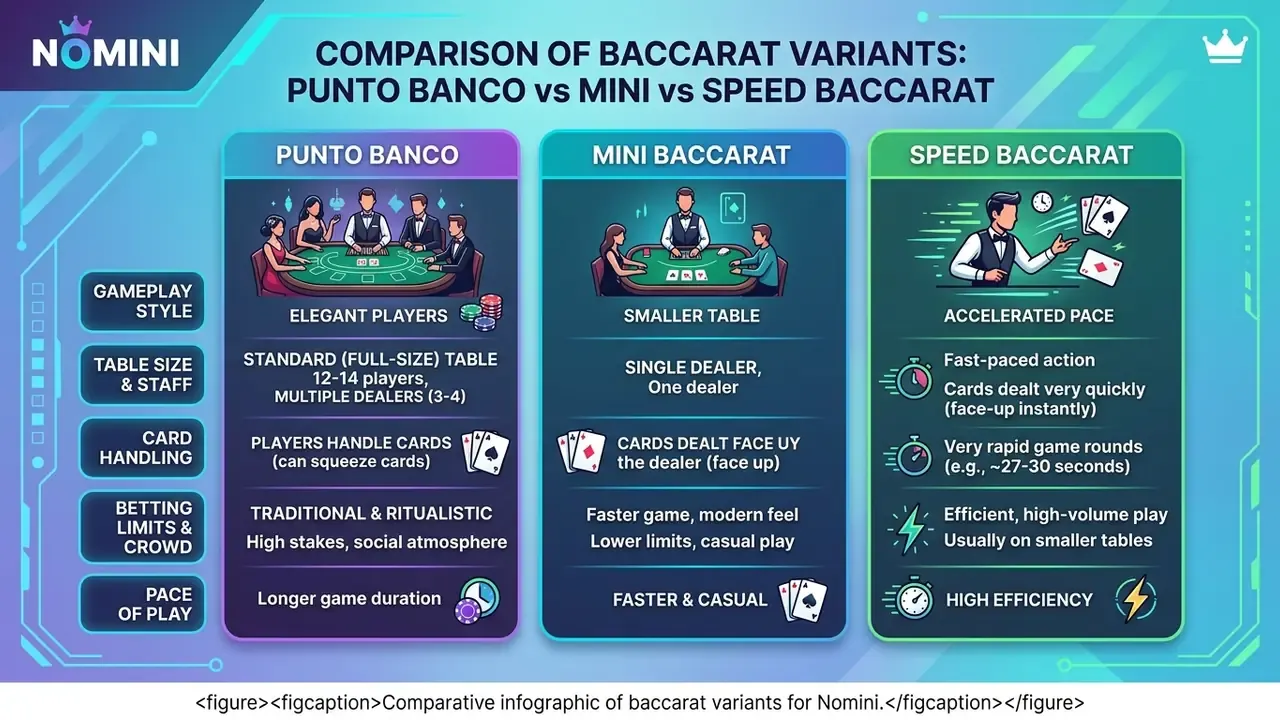

- Punto Banco:the classic standard game where the house banks all wagers and strict tableau rules govern dealing. Regulated layouts seat 10 to 14 players.
- Mini Baccarat:a smaller 7-to-9 player table where dealing is fully automated or handled by a single croupier, so rounds complete faster. Regulations typically state that the dealer shuffles and a player only cuts the shoe.
- Speed Baccarat:a live-streamed variant that squeezes round duration from about 48 seconds down to around 27 by dealing cards face-up and shortening betting windows.

Punto Banco and Mini Baccarat
Punto Banco developed as a casino-banked format in 1940s and 1950s Havana before spreading across North American and European venues. Academic work by Ethier and Lee (2015) describes it as a house-banked baccarat form introduced in pre-revolutionary Havana and today "the most widely played form of baccarat", a characterisation echoed by the rules archive Pagat. Mini Baccarat adapts those exact mechanics to compact layouts, with industry guides reporting up to 200 hands per hour. That figure comes from commercial baccarat guides rather than regulator data, so treat it as an upper-bound estimate.
«Speed Baccarat shortens the average round from ~48 to ~27 seconds, raising rounds per hour by 30–40% while the house edge stays unchanged.» — Live Dealer Casino Analytics: Speed Baccarat Format Analysis (2024). https://nomini-india.com

The implication is arithmetic, not strategic. House edge is charged per hand, so a faster table multiplies your exposure. At ₹500 per hand on Banker, 60 hands per hour implies roughly ₹318 in theoretical hourly cost; at 130 hands per hour the same stake implies about ₹690. In traditional land-based Punto Banco, seated players occasionally pass the shoe or handle cards. In digital Mini Baccarat and online software adaptations, the system or live dealer manages every card movement. That streamlined flow raises wagering volume per session, which is exactly why bankroll management and stop-loss boundaries matter more here than at a slow table.
Other Variants: Chemin de Fer, Baccarat Banque, European, Dragon Tiger, Macau and 3-Card Baccarat
Beyond Punto Banco, several regional and historical variants circulate in online lobbies and land-based casinos. The differences matter, because they change who banks the game, how many decks are used, and what the payouts look like.
| Variant | Who banks / key difference | Decks | Notable payouts |
|---|---|---|---|
| Chemin de Fer | Players bet against each other; the banker role rotates anticlockwise, and the acting banker covers other players' bets. Tactical choice on drawing a fifth card exists. | 6 | Player win 1:1; 5% commission on winning banker hand; ties carry over to the next round |
| Baccarat Banque | Players bet against a banker funded partly by the house; the banker is the player making the largest wager. In Deux Tableaux, three two-card hands are dealt (two Player, one Bank). | 3 | Player 1:1; Banker 19:20 (5% edge); no conventional tie bet |
| European Baccarat | The player may choose to stand or draw on a total of 5; the banker may draw a third card at will. The casino funds the bank, and if one player covers the bank, others sit out that round. | 6–8 | Standard 1:1 payouts with 5% banker commission |
| Dragon Tiger | A simplified two-card duel: Dragon and Tiger each receive one card, and the higher card wins. | 6–8 | Main bet 1:1 (house edge ≈ 3.73%); Tie 8:1 with a very high 32.77% house edge |
| Macau Baccarat (Macao) | Players go bust and exit the round if their score exceeds nine; only the Player hand may be backed, and the banker role rotates clockwise. | 2 | Natural nine 3:1; natural eight 2:1; other wins 1:1 |
| 3-Card Baccarat | Single-deck, fast format where the highest-scoring hand wins, with the greatest number of face cards deciding the main bet and points breaking ties. | 1 | Player 97:100 (≈3% house edge); Tie 25:1; dealer points bet 8:1 |
For Indian players the takeaway is simple. Punto Banco and its live derivatives (Mini, Speed, No Commission) dominate online lobbies, while Chemin de Fer and Baccarat Banque survive mostly in European land-based casinos such as Monte-Carlo. Dragon Tiger deserves the most caution: its Tie bet is among the worst-value wagers on any casino floor.
How to Choose a Live Baccarat Casino
Picking a reliable baccarat live casino comes down to verifying software provider licensing, checking table limit ranges, inspecting side bet availability, and testing mobile stream stability.
Leading live casino studios such as Evolution Gaming and Pragmatic Play publish product-level game rules and certified RTP tables. Evolution documents default Pairs plus optional Player Bonus, Banker Bonus, Either Pair and Perfect Pairs (paying up to 200:1), while Pragmatic Play's rule sheets specify table minimums, maximums and Super 6 payouts. When you evaluate live tables, review:

- Provider reputation:certified operations from licensed studios with published, downloadable rule sheets.
- Side bet rules:clear payout structures for optional bets such as Player Pair, Banker Pair, Perfect Pair and Super 6.
- Table limits:visible minimum and maximum stake boundaries for conservative budgets and high-roller accounts alike. Critical if you use any progression system, since limits cap it.
- Interface options:availability of roadmap scorecards (Big Road, Bead Plate, Cockroach Pig) for tracking outcome histories.
- Commission model:whether the table runs standard 5% commission or No Commission (Banker-6 pays 1:2), since this changes payout maths.
- Mobile performance:stream stability on 4G, adjustable video quality, and portrait-mode support.

How to Access a Baccarat Casino and Assess Playing Conditions
Getting into a baccarat casino safely means verifying operator licences, inspecting random number generator (RNG) audit certificates, reviewing INR and UPI payment flows, and reading bonus terms before you fund a real balance.
```
[❓ QUIZ: Readiness checklist for baccarat real-money play. Caption: “5 questions before your first deposit: licence, limits, payouts, bonus terms, responsible-gambling tools”.]
Purpose: Guide the user step by step through verifying casino safety before transferring funds.
Semantics:
«In the Pennsylvania Interactive Gaming Assessment 2023, the share of online gamblers screening positive for problem gambling exceeded 50%, and helpline calls related to online play rose from 20% to 34%.» — Pennsylvania Department of Drug and Alcohol Programs, Interactive Gaming Assessment (2023). https://www.pdap.pa.gov
That regulatory data matters for a game like baccarat, where round speed and one-click re-bets can quietly multiply your exposure inside a single session.
⚠️ Bonus pitfalls for baccarat players, read before opting in Recently our review desk audited an India-facing casino platform advertising a 100% welcome package. In the fine print, table games like baccarat contributed only 5% toward a 35x wagering requirement. Clearing a ₹10,000 bonus at that weighting would demand roughly ₹70,00,000 in baccarat turnover. We advised readers to skip the promotional opt-in and play with an unencumbered cash balance instead, rather than lock up withdrawal funds. Three clauses to check every time: (1) game weighting for table games; (2) the maximum bet allowed while a bonus is active, often ₹200 to ₹500, since breaching it can void winnings; (3) whether wagering must be completed before any withdrawal, including your original deposit.
Detailed analyses of operator review metrics, wagering terms and compliance standards sit in our comprehensive guide on iGaming platform evaluation.
When to Choose Baccarat Demo
Baccarat demo suits absolute beginners who need to learn point aggregation, follow the third-card tableau, and get comfortable with digital betting interfaces without risking money.
Demo software gives you a risk-free space to see how different stake sizes move a virtual balance across 50 to 100 simulated rounds. You can confirm whether your mobile browser handles the graphics smoothly before registering an account. You can also watch how outcome frequencies in a short session, say 200 hands, deviate sharply from the reference distribution of Banker 45.86%, Player 44.62%, Tie 9.52%. That is a useful lesson in variance before cash is involved.
«An evidence review rated at medium confidence found that simulated gambling is associated with problem gambling behaviour, particularly where monetised mechanics are present.» — Australian Gambling Research Centre, Literature Review on Simulated Gambling (2023). https://aifs.gov.au
So demo play is a learning tool, not a harmless habit. Use it to master the interface and the tableau, set a fixed budget before switching to cash, and never treat a winning demo streak as evidence that a system works.
What to Check Before Playing Baccarat for Real Money
Before depositing real money for baccarat play, verify four operational criteria to protect your funds and confirm fair gaming standards.
- Regulatory licensing: check public licence registers such as the Malta Gaming Authority (MGA), the Curaçao Gaming Authority (LOK framework, effective 24 December 2024), or the UK Gambling Commission register. Search by licensee name, URL and authorisation status, not by the logo in the footer.
- RNG and fairness certification: look for audit seals from independent test laboratories such as eCOGRA, iTech Labs, or GLI in the site footer. No published certificate or audit reference means the fairness claim is unverified.
- Payment and withdrawal options: confirm that localised methods like UPI, IMPS, NetBanking or e-wallets work for both deposits and cashouts, with transparent processing timelines, stated minimum and maximum limits, and any fees.
- Responsible gambling controls: make sure the platform offers self-exclusion, daily or monthly deposit limits, and session time reminders inside account settings. Regulatory standards in mature markets require deposit, time and loss controls to be available before play begins.
Disclaimer: This information is general in nature and does not constitute legal or financial advice. Before registering, confirm that the platform complies with the legislation applicable in your jurisdiction.

Legality, Payments and Taxes for Players in India


State-level restrictions. Gambling in India is regulated at both central and state level, and the picture changes often. Several states, including Telangana, Andhra Pradesh, Assam, Odisha, Nagaland and Sikkim, have historically legislated against or tightly licensed online real-money gaming, while Goa, Daman and Sikkim permit specific land-based or state-licensed offerings. Court rulings in Tamil Nadu and Karnataka have repeatedly shifted enforcement in recent years. Because the Promotion and Regulation of Online Gaming Act, 2025 and its implementing guidelines materially change the national framework, the current status of any specific platform needs independent verification with a qualified legal adviser before you play. (This point requires up-to-date legal confirmation and should not be read as a compliance opinion.)
Age thresholds. International practice varies. 18+ is the common baseline, for example under Russia's federal law and Sweden's Gambling Act, whereas regulated markets such as the Philippines set 21+ under PAGCOR's Responsible Gaming Code, and Sweden adds a 20+ entry rule for Casino Cosmopol. Licensed operators must verify age and identity before gambling begins.
Payments: UPI, IMPS and NetBanking. The most common friction points reported by Indian players are these:
- KYC completion before the first withdrawal. Upload PAN, Aadhaar-based address proof and a bank statement matching your deposit method before you win, not after.
- Name mismatches between the casino account and the UPI or bank account. This is the single most frequent cause of rejected payouts.
- Closed-loop payout rules. Many operators return funds only to the deposit source, so a deposit made through a friend's UPI ID can freeze a withdrawal permanently.
- Processing windows. E-wallets and crypto usually settle fastest; NetBanking and bank transfers commonly take 1 to 5 working days, and weekend requests queue to the next business day.
- Payment-processor blocks. Intermediary declines happen often, so keep a second verified method available.
Taxation. Winnings from online games in India are taxed at a flat rate on net winnings, with tax deducted at source (TDS) by the payer, currently 30% plus applicable cess under the online-gaming provisions introduced by Sections 115BBJ and 194BA of the Income Tax Act. There is no basic exemption threshold for this category, and losses cannot be set off against other income. Tax treatment of offshore platforms is contested and enforcement keeps evolving, so consult a chartered accountant about your specific situation.
If play stops being entertainment. Support is available in India through NIMHANS' SHUT Clinic (Service for Healthy Use of Technology) in Bengaluru, the national mental-health helpline Tele-MANAS (14416), and international services such as Gamblers Anonymous. Most licensed platforms also provide deposit limits, cooling-off periods and self-exclusion inside account settings.
Baccarat Strategy: How to Bet Consciously
Disclaimer: This information is general in nature and does not replace professional advice. Real-money play involves financial risk. If you are struggling to control your gambling behaviour, contact a psychological support helpline such as Tele-MANAS (14416) in India.
A sound baccarat strategy focuses on two things only: selecting low-house-edge wagers and managing your bankroll with discipline. It cannot alter fixed probabilities, and it cannot predict streaks.
«An analysis of 17.97 million baccarat hands found that most gamblers display positive recency — betting on a streak continuing rather than breaking.» — PubMed, Baccarat Gambler Behaviour Study (2023). https://pubmed.ncbi.nlm.nih.gov
That behavioural finding explains why roadmaps sit so prominently on live tables. They feed a pattern-seeking instinct that the underlying maths simply does not reward. Progressive betting systems get cited constantly by players, so here is what each one actually does in real-money baccarat:

- Martingale:double the bet after every loss (10 → 20 → 40 → 80 INR). A single win recovers previous losses plus the base stake, but six or seven consecutive losses drain bankrolls and slam into table maximums. The required bankroll grows geometrically as $B(2^n - 1)$: after seven straight losses at a ₹100 base, the next stake alone is ₹12,800 and cumulative exposure passes ₹25,000.
- Paroli:a positive progression that doubles the stake after each win, up to three consecutive wins, then resets to the base unit. It limits downside during losing runs without changing the game's negative expectation.
- Fibonacci:raise stakes along the sequence (1, 1, 2, 3, 5, 8, 13...) after a loss, then step back two places after a win. Slower capital consumption than Martingale, still vulnerable to extended losing runs.
«In a game with negative expectation, any betting system merely redistributes variance without changing the house edge.» — Wizard of Odds, Analysis of Betting Systems (2024). https://wizardofodds.com
Practical baccarat play should favour the Banker hand for its 1.06% house edge, avoid the 14.36% Tie bet, and fix loss limits before the first deal. A workable session framework looks like this: set a session budget you can afford to lose entirely, size each bet at 1% to 2% of that budget, apply a hard stop-loss (say, 50% of the budget) plus a walk-away win target, and prefer slower tables over Speed Baccarat when your bankroll is small. Treat every round as paid entertainment. Hold your stop-loss. Never gamble with money reserved for essential living expenses.
Common Mistakes to Avoid
Even with correct bet selection, avoidable errors cost players more than the house edge ever will.
- Chasing losses. Raising stakes to claw back a deficit is the fastest documented route to bankroll exhaustion, and the next hand's maths is unchanged by the last one.
- Reading roadmaps as predictions. Big Road patterns are records, not signals. Independence means the shoe has no memory.
- Over-engineering systems. Layering Martingale onto Fibonacci onto side-bet triggers creates confusion, not edge. Simplicity protects discipline.
- Ignoring table limits. Every progression dies at the table maximum, so check it before you start, not mid-streak.
- Playing Speed Baccarat with a small bankroll. Doubling round frequency doubles theoretical hourly cost.
- Opting into bonuses without reading game weighting. A 5%-weighted table game turns a 35x requirement into an effectively unclearable condition.
- Skipping KYC until withdrawal time. Verification delays are the most common complaint among Indian players, so finish it on day one.
- Treating side bets as a core strategy. A 10% to 14% edge cannot be offset by any staking pattern.
FAQ
The legal position depends on your state and on the central framework introduced by the Promotion and Regulation of Online Gaming Act, 2025 and its 2026 guidelines. Several states maintain their own prohibitions or licensing rules, and enforcement keeps evolving. Verify the current status with a qualified legal adviser before depositing. This article is not legal advice.
Many India-facing platforms list UPI, IMPS, NetBanking, e-wallets and crypto. Withdrawals are usually restricted to the deposit source and require completed KYC in your own name. Expect near-instant deposits and 1 to 5 working days for bank-rail withdrawals. Intermediary declines are common, so keep a second verified method ready.
Online gaming winnings fall into a flat-rate category with tax deducted at source, currently 30% plus applicable cess on net winnings under Sections 115BBJ and 194BA of the Income Tax Act, with no basic exemption and no set-off of losses. Consult a chartered accountant, particularly for offshore platforms.
The Banker bet, at a 1.06% house edge even after the 5% commission. Player sits at 1.24%. Avoid the Tie at 14.36% and treat side bets (10% to 14%+) as entertainment spending.
Licensed RNG baccarat is independently tested by laboratories such as eCOGRA, iTech Labs and GLI, and large-scale simulations show empirical outcome frequencies tracking theoretical probabilities within a fraction of a percent. Live dealer baccarat uses physical cards read by optical recognition on camera. Always check for a published audit seal and a valid licence entry.
Yes, on RNG titles that offer a demo mode with virtual credits. Live dealer tables are generally real-money only, because streamed rounds share betting positions with paying players. Demo balances reset on refresh and cannot be withdrawn.
No, not in any practical sense. The theoretical advantages that appear late in a shoe are tiny and occur far too rarely to overcome the commission and the house edge, which is why analysts describe baccarat card counting as a fallacy.
No. Under a standard shuffled-deck model each hand is statistically independent, so streak-based systems and roadmap "patterns" carry no predictive value.
It pays Banker wins at 1:1 except when the Banker wins with 6, which pays 1:2. It removes fractional payout maths, but the house edge stays broadly comparable to standard 5%-commission baccarat.
Rounds run about 27 seconds against roughly 48 seconds on classic tables. The odds per hand are identical. Only your number of hands per hour, and therefore your expected hourly cost, goes up.