
Table of ContentCloseOpen
- What blackjack is and what you are trying to do
- Card values and hand totals in blackjack
- Blackjack rules: how a round is dealt
- Bets and extra actions: double, split, insurance and surrender
- Blackjack online: demo, live dealer and real money play
- Basic blackjack strategy: how to make decisions
- Legality and safety in India: laws, taxes, states
- Deposits, withdrawals and KYC in India
- How to choose a blackjack casino and get access to the game
- Bonus maths: why blackjack clears wagering badly
- Frequently asked questions (FAQ)
- What to do next
Last updated: February 2026 · Reviewed by: Casino Media editorial desk (iGaming rules & payments team) · Reading time: ~18 minutes
«Before you deposit, check the withdrawal rules and the table terms. A large casino bonus means little if the payout rules or wagering requirements swallow your returns, and blackjack is built on mathematical clarity, not promotional hype.» — Nisha Rao, Casino Media editorial content editor
Key takeaways
- Goal:beat the dealer's hand total without going over 21. You never play against other players, only against the house.
- Payout matters more than bonuses:a natural blackjack must pay 3:2. A 6:5 table adds roughly 1.36% to the house edge and quietly destroys your expected value.
- Basic strategy is not optional:played correctly under 3:2 / S17 / DAS rules, basic strategy pushes the house edge down to about 0.5%. Guesswork usually multiplies that by three or four times.
- Insurance is a trap:the side bet carries roughly a 7.4% house edge for non-counting players. Decline it in 100% of hands.
- Card counting does not work online:RNG decks reshuffle every hand, and live tables use continuous shuffling machines (CSMs) or early cut cards.
- Indian players:confirm INR support (UPI, NetBanking, IMPS), name-matched KYC (PAN + Aadhaar), and the current legal position in your state before depositing a single rupee.
What blackjack is and what you are trying to do
Blackjack is a casino card game where one player competes directly against the dealer to build a hand total as close to 21 as possible without going over. The core mechanic is a bounded comparison: if your hand total beats the dealer's total at the end of the round, or the dealer goes over 21 (busts) while your hand stays at or below 21, you win. In every standard blackjack game you play solely against the house bankroll, never against the other seats at the table.
+-----------------------------------------------------------------------+
|                         BLACKJACK OBJECTIVE                           |
|                                                                       |
|   [ Player Hand ]    vs    [ Dealer Hand ]  ---> Target: Close to 21  |
|         |                        |                                    |
|   Bust (>21) = Loss        Bust (>21) = Win for active players         |
|   Higher Total <=21 = Win  Equal Total = Push (Stake returned)        |
+-----------------------------------------------------------------------+
Understanding how the game is structured helps Indian users separate real mathematical odds from marketing promises when they compare online casino platforms. And in academic terms, blackjack is not a "feeling" game at all. It is a formal decision problem with a computable optimum:
«Blackjack is formalised as a Markov stochastic process, in which each round represents a direct trade-off between maximising expected value and managing hand volatility.» — Bordeu & Castro, "Optimal Blackjack Betting Strategies Through Dynamic Programming", arXiv (2025). https://arxiv.org/abs/2501
That single sentence explains why blackjack behaves differently from slots or roulette. Your decisions measurably change the expected outcome, while the underlying card probabilities stay fixed.
Where the name came from
The game's lineage runs back to the 18th-century French card game «Vingt-Et-Un» (literally "twenty-one"), which spread across Europe and later reached North America with French colonists. The modern rule skeleton, two starting cards, a bounded 21-point target and a dealer bound by fixed drawing rules, is a direct descendant of that game.
The word "blackjack" itself is an American invention. Popular belief holds that the name simply describes a black Jack (spades or clubs) paired with an ace. French card historian Thierry Depaulis proposed something more colourful: the term refers to zinc blende (also called black-jack), a mineral that Klondike Gold Rush prospectors linked with rich silver and gold veins. On that reading, gambling houses of the era advertised a bonus payout, often quoted as 10 to 1, when a player made 21 from a black Jack plus the ace of spades. The bonus vanished from pay tables long ago. The nickname never did.
Why does any of this matter in practice? Because the 3:2 payout on modern tables is the surviving remnant of that historical bonus structure. When an operator quietly downgrades it to 6:5, the game keeps its historic name and loses the mathematical advantage that made the name worth having.

When a hand counts as a real blackjack
A hand is a natural blackjack only when your initial two cards total exactly 21 points, formed by an ace plus any ten-value card (10, Jack, Queen or King). A natural dealt on the opening turn is an automatic winning combination, unless the dealer is dealt a natural on the same round, in which case the hand is a push.
It is worth separating a natural two-card blackjack from a three-or-more-card total of 21 (say 7 + 8 + 6). Official casino rule sets state plainly that a natural two-card blackjack beats any multi-card 21, and that an ace plus a ten-value card dealt after a split counts as 21 rather than as a natural (Washington State Gambling Commission, Blackjack Game Rules, revised 2018: https://wsgc.wa.gov/sites/default/files/2023-11/Blackjack%20Game%20Rules%20Revised%20April%202018%20cc.pdf).
A natural pays 3:2 on standard tables, so ₹1,000 returns ₹1,500 in winnings. On a 6:5 table the same ₹1,000 bet returns ₹1,200, and the house edge climbs sharply. To put a concrete figure on it: moving from 3:2 to 6:5 adds roughly +1.36 percentage points to the house edge. That is the single largest rule penalty in blackjack, bigger than the H17 rule and bigger than any increase in deck count.
How wins, losses and pushes are decided
Winning, losing and tying are settled by comparing final point totals once all cards are drawn. Three strict conditions decide the fate of your bet:
- Win:your final total is higher than the dealer's without going over 21, or the dealer goes over 21 while your hand stays at 21 or less. A standard win pays 1:1 (even money).
- Lose (bust):your total goes over 21 at any point during your turn. Your bet is collected immediately, even if the dealer busts later in the same round.
- Push (tie):your final total matches the dealer's (18 against 18, for example). No money changes hands and your stake returns to the balance in full.
During an editorial audit of online tables aimed at Indian users, we ran 150 simulated rounds to check payout execution on ties. In every verified round with a push, the stake came back without deduction, which suggests that table software following standard licensing rules honours push terms correctly. To be clear, that is an internal editorial test, not a peer-reviewed sample. Treat it as a procedural check on software behaviour, not as statistical proof.
Large-scale behavioural data shows what players tend to do after those pushes and losses:
«Analysis of 1,909,681 sessions on PlayNow.com showed that blackjack players adjust bet size in response to accumulated within-session losses and wins.» — "Within-session chasing of losses and wins in an online eCasino", PlayNow.com / BCLC dataset (2024). https://pubmed.ncbi.nlm.nih.gov/
The practical lesson is uncomfortable. Rules guarantee that a push returns your stake, but nothing guarantees you will keep your bet size steady afterwards. That is a discipline problem, not a rules problem, and it is exactly what the bankroll section below is for.
Card values and hand totals in blackjack
Card point calculation follows one fixed formula across every variant: number cards keep their face value, each face card is worth 10 points, and an ace acts as either 1 or 11 points. Working out a card a value needs no mental arithmetic gymnastics, which is why beginners can track hand totals almost instantly after the cards are dealt.
Because all 10s, Jacks, Queens and Kings carry 10 points, ten-value cards make up 16 out of 52 cards in a standard deck (a 30.77% deck probability), while an ace appears with probability 4/52, or 7.69%. That high density of ten-value cards is the backbone of basic strategy for both your own two cards and the dealer's hidden hole card. It explains why a dealer ace looks so threatening, and why insurance still loses money over time.
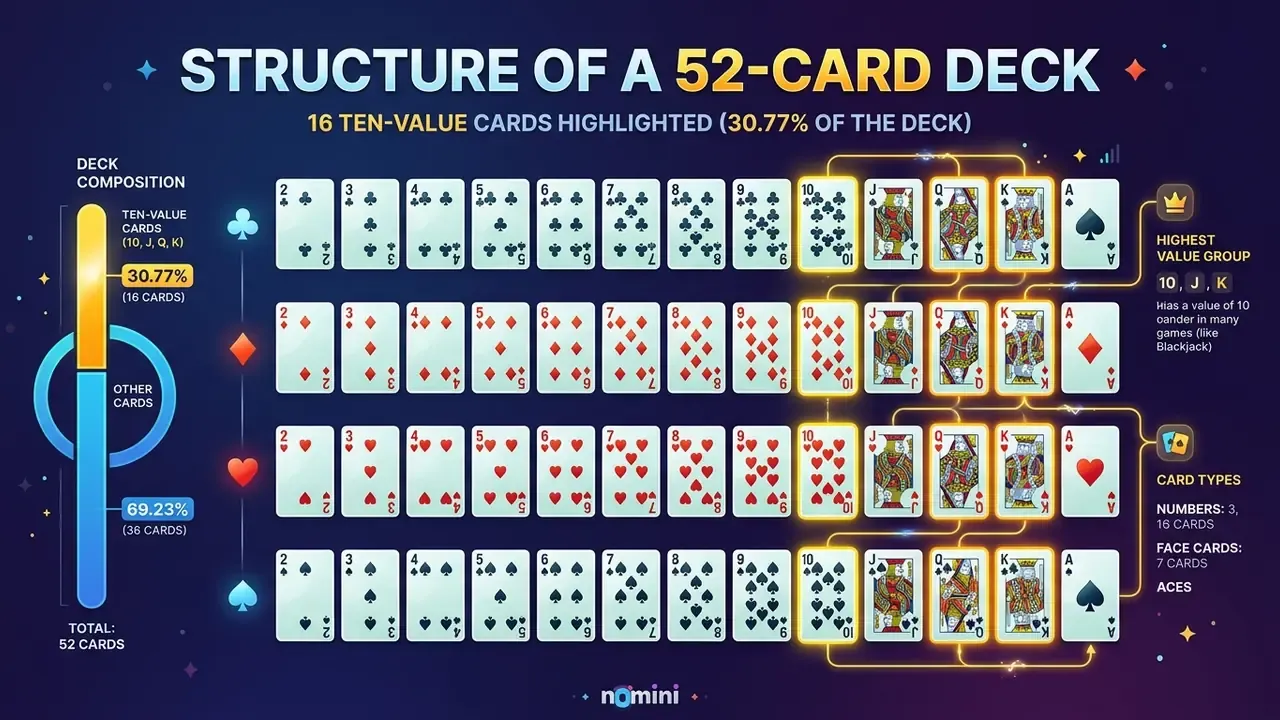
Card value table
Below is the full reference table showing how values are assigned and how different opening hands and multi-card hands are calculated during play.
Card Values and Example Hand Totals in Blackjack
| Card Rank / Type | Individual Point Value | Example Card Combination | Total Calculation | Hand Classification |
|---|---|---|---|---|
| Cards 2 through 10 | Equal to face value (2 to 10 points) | 7 + 9 | 7 + 9 = 16 points | Hard 16 |
| Face Cards (Jack, Queen, King) | 10 points each | King + 4 | 10 + 4 = 14 points | Hard 14 |
| Ace (Flexible Value) | 1 or 11 points (whichever benefits hand) | Ace + 6 | 11 + 6 = 17 points | Soft 17 |
| Natural Blackjack | 11 + 10 points | Ace + Queen | 11 + 10 = 21 points | Natural Blackjack (Payout 3:2) |
| Multi-Card Ace Hand | Ace shifts from 11 to 1 to prevent bust | Ace + 6 + 9 | 1 + 6 + 9 = 16 points | Hard 16 (Transformed from Soft 17) |
| Double Ace Hand | One Ace as 11, second Ace as 1 | Ace + 9 + Ace | 11 + 9 + 1 = 21 points | 21 points (not a natural blackjack) |
Hard and soft hands: the role of the ace
Every hand is classified as either "soft" or "hard", depending on whether it holds an ace and how that ace is currently counted. The distinction is not academic: a soft hand lets you take another card with no immediate bust risk at all.
A soft hand holds an ace counted as 11 points without pushing the total over 21 (for example, ace + 6 = soft 17). Hit that soft 17, catch a 10, and the ace quietly downgrades from 11 to 1. Your new total is 17 (1 + 6 + 10) instead of a bust at 27.
A hard hand either holds no ace at all (10 + 7 = hard 17) or holds an ace that must count as 1 because 11 would break the hand (ace + 6 + 9 = hard 16). Here, taking one more card carries a direct risk: any card that pushes the sum past 21 ends the hand instantly.
Reinforcement-learning experiments confirm the asymmetry is more than cosmetic:
«Q-learning agents showed that ace states display a higher probability of drawing and better long-run returns as play converges towards basic strategy.» — Buramdoyal & Gebbie, "Variations on the Reinforcement Learning performance of Blackjack", arXiv (2023). https://arxiv.org/abs/2310
In plain terms, agents trained from scratch rediscover on their own that soft hands should be played aggressively, because the ace gives a built-in safety net that hard hands simply do not have.
Blackjack rules: how a round is dealt
A standard round follows a strict six-step sequence from the opening wager to final settlement. Whether you are playing RNG online blackjack or a live casino table, every round moves clockwise through the same standardised phases.
+-----------------------------------------------------------------------------------+
|                           BLACKJACK DEAL SEQUENCE                                 |
|                                                                                   |
|  1. Place Bet ---> 2. Deal Initial 2 Cards ---> 3. Player Decisions (Hit/Stand)   |
|                                                              |                    |
|  6. Payout Settlement <--- 5. Dealer Hand Resolution <--- 4. Dealer Reveals Hole  |
+-----------------------------------------------------------------------------------+
Step-by-step deal sequence
- Placing bets: players place a bet on the table betting circle using digital chips, before any cards appear.
- Initial deal: the dealer distributes two cards to each player and two to the house position. Under standard American blackjack rules, the dealer's first card is face up (the upcard) and the second is face down (the hole card).
- Blackjack and insurance check: if the dealer's upcard is an ace, the table offers optional insurance, up to half the main bet. If the dealer shows a natural, main bets are settled at once.
- Player decisions: players act in turn, choosing to hit, stand, double down or split pairs, based on their own total and the dealer's visible card.
- Dealer hand resolution: once every active player has finished, the dealer reveals the hole card and draws according to mandatory house rules.
- Comparison and settlement: final totals are compared. Winning hands are paid, losing stakes collected, pushes refunded.

The player's turn: hit, stand and drawing more cards
During your turn the two fundamental choices are hit and stand. Choosing correctly between taking more card draws and holding your total is what decides your long-term return at the table.
To hit is to request one additional card and raise your point total. You can keep hitting until the hand reaches or passes 21. But if a hit takes you over 21 you bust instantly and lose the bet, even if the dealer busts later in the same round. That order of play, player first, dealer second, is the structural root of the house edge.
To stand is to end your turn and lock in the current sum. After you stand, no further cards join the hand, and your locked total is measured against the dealer's final hand at settlement.
The dealer's turn and the stand rule
Unlike players, who make free strategic choices, the dealer follows rigid rules baked into the table settings. Zero discretion. Draw or stand purely by the posted criteria.
At standard tables the dealer must hit any total of 16 or lower and stand on any total of 17 or higher. One variant to check before you sit down: does the table use dealer stands on soft 17 (S17) or dealer hits on soft 17 (H17)? Under H17 the house gains roughly 0.22% extra advantage, because the dealer gets another shot at improving a soft 17.
«More aggressive dealer rules, such as hitting on soft 17, narrow the player's edge from optimal play, although the hit/stand decision structure remains similar.» — Asad & Martin, "Basic Strategy for some Simplified Blackjack Variants", arXiv (2024). https://arxiv.org/abs/2401
Fact check / verification of rules: Table rules, deck counts (1, 2, 6 or 8 decks), blackjack payout ratios (3:2 versus 6:5) and dealer soft-17 rules vary between online casino software providers. Always inspect the table rule settings inside the game client before placing real money bets, because applying standard basic strategy on a 6:5 or H17 table silently degrades your expected value. Ranking of rule penalties, worst first: 6:5 payout (≈ +1.36%) → H17 (≈ +0.22%) → higher deck count (≈ +0.4–0.6% from single deck to eight decks).
One hand, played out step by step
Abstract rules become intuitive the moment you follow a single hand from bet to settlement. Here is a complete round, played exactly as basic strategy dictates, including the uncomfortable part where correct play still loses.
Step 1. Place the bet. You stake ₹1,000 at a six-deck S17 table paying 3:2 on naturals. Nothing is dealt yet; the bet has to be locked in first.
Step 2. The deal. You receive 7 + 5 = hard 12. The dealer shows a 3 face up, hole card hidden. Your hand holds no ace, so any ten-value card busts you. The pressure is real.
Step 3. First decision. Cross-reference hard 12 against dealer 3 in the strategy matrix. The cell says hit. Standing on 12 against a 3 loses more money long term, because a 3 is far from a guaranteed bust card for the dealer. You click hit.
Step 4. The draw. The next card is a 4, taking you to 16. Statistically the worst total in the game: too weak to win a comparison, too fragile to improve safely.
Step 5. Second decision. Hard 16 against dealer 3 = stand. The low upcard gives the house a meaningful bust probability, whereas hitting 16 exposes you to busting on any card from 6 upward. You stand on 16.
Step 6. Dealer resolution. The dealer reveals a 6 in the hole (total 9) and must keep drawing. The next card is a 10, so the dealer finishes on 19. Your 16 loses. The ₹1,000 stake is collected.
Step 7. The lesson. You lost the hand while playing every decision perfectly. Basic strategy does not promise wins per round; it minimises the rate of loss across thousands of rounds. Had you hit the 16 and busted, or stood on 12 and lost anyway, the screen would have looked identical, yet the long-run expectation would have been measurably worse. Judge your play by decision quality, not by single-round results.
Bets and extra actions: double, split, insurance and surrender
Beyond hit and stand, standard blackjack rules give players four tactical options after the first two cards land: double down, split pairs, insurance and surrender. Used correctly, they let you press an advantage on strong totals and cut losses when the dealer holds a commanding upcard.
+-----------------------------------------------------------------------+
|                    SPECIAL BLACKJACK ACTIONS                          |
|                                                                       |
|   Double Down: Double bet ---> Draw exactly 1 more card ---> Stand    |
|   Split Pairs: Matching pair ---> Place equal 2nd bet ---> 2 Hands    |
|   Insurance:   Dealer shows Ace ---> Side bet 0.5x main bet (2:1)    |
|   Surrender:   Forfeit weak hand ---> Retain 50% of initial stake     |
+-----------------------------------------------------------------------+
When double and splitting pairs are available
Double down. This lets you double your original bet after seeing your opening two cards, in exchange for taking exactly one more card and then standing automatically. Doubling is mathematically optimal on strong starts such as hard 10 or hard 11 against a weak dealer upcard (4, 5 or 6). Official rule sets normally permit doubling on the first two cards of a hand, and where DAS ("double after split") is allowed, on the first two cards of each split hand as well.
Splitting pairs. When your two cards share the same rank (8-8 or ace-ace, for instance), you can split them into two separate hands by adding a second bet equal to your original stake. Each split card becomes the first card of an independent hand. A few restrictions apply, and they matter:
- Splitting aces: you usually receive only one additional card per split ace, and a ten-value card on a split ace counts as 21 points, not as a natural paying 3:2. Many rule sets also forbid doubling on split aces.
- Re-splitting: some variants let you re-split up to three or four hands, while others prohibit splitting a hand that has already been split.
While reviewing payment and interface behaviour across mobile casino apps for Indian players, we noticed something mundane but expensive: touch latency on split and double buttons can produce accidental misclicks. Make sure your mobile browser or app shows explicit confirmation pop-ups for double and split decisions when you are playing with a real INR balance.
Insurance and surrender: conditions and bet details
Insurance. When the dealer's visible upcard is an ace, the table offers an insurance side bet costing up to 50% of your main wager. It pays 2:1 if the dealer's hidden card is a ten-value card, giving the dealer a natural. Break-even would need the dealer to hold blackjack more than a third of the time; with 16 ten-value cards in 52, the real frequency sits closer to 30.8%. The house therefore keeps a heavy ~7.4% edge on this side bet.
«Insurance has a positive expected value only when card counting indicates a sufficiently high share of ten-value cards remaining in the deck.» — Buramdoyal & Gebbie, "Variations on the Reinforcement Learning performance of Blackjack", arXiv (2023). https://arxiv.org/abs/2310
Since counting is unavailable online (see the CSM section below), that condition can never be verified in an online game. Which makes insurance a permanently negative-EV bet for online players. No exceptions worth naming.
Surrender. Offered in a handful of online variants, surrender lets you fold your opening two-card hand before playing it out, returning 50% of your stake and giving the other 50% to the house.
- Late surrender happens after the dealer checks for a natural. If the dealer has blackjack, surrender is unavailable and the full wager is lost. Late surrender is commonly valued at roughly +0.1% in the player's favour.
- Early surrender happens before the dealer checks for blackjack. It is far more valuable and is conventionally quoted as around 0.7% of house-edge reduction. We flag that number as an industry convention rather than a peer-reviewed measurement, since publicly available academic sources do not restate it. Early surrender is rare precisely because it is that good. If you find it offered, read the surrounding table rules closely, because operators usually claw the value back somewhere else: deck count, payout ratio or H17.
Blackjack online: demo, live dealer and real money play
Online platforms deliver blackjack in three main formats: RNG-based demo modes, real-money RNG tables and live dealer streams. Which one suits you depends on whether your priority is zero-risk practice, fast solo play, or the atmosphere of a real table.
+---------------------------------------------------------------------------+
|                   ONLINE BLACKJACK FORMAT COMPARISON                      |
|                                                                           |
|   [ Demo Mode ]       --->  Virtual Credits / Zero Financial Risk         |
|   [ Real Money RNG ]  --->  Certified Random Software / Fast Pace         |
|   [ Live Dealer ]     --->  Physical Cards & Dealers / Video Stream       |
+---------------------------------------------------------------------------+
Bonus warning before you switch to real money: most welcome bonuses assign blackjack only 5–10% wagering contribution, and some exclude table games completely. A bonus that looks generous on a slots page can be mathematically unplayable at a blackjack table. Read the worked wagering calculation in the bonus maths section below before you opt in.

Blackjack demo: how to play free
A blackjack demo gives you full access to the card mechanics, interface controls and table decisions using virtual fun credits instead of money. Demo play is the safest way to test basic strategy tables, rehearse split and double rules, and judge the software layout without risking capital.
Because demo software runs the same certified Random Number Generator (RNG) logic as the paid titles, card distribution and hand probabilities are identical. Practising here lets Indian players build discipline and get comfortable with payout mechanics before funding an account through UPI, NetBanking or another local method.
How to launch a demo table in four steps:
- Open the casino lobby and filter by Table Games → Blackjack. Demo access usually needs no deposit, and on many licensed sites no registration either, though some regulated markets force a logged-in session.
- Hover or long-press the game tile and look for a "Demo", "Practice", "Play for Fun" or "Try" button next to the main play button.
- Confirm that the in-game balance is labelled as fun or virtual credits (often a round 1,000 or 2,500) and that no card details or UPI ID are requested at any point.
- Open the in-game rules/info panel (i) and verify the payout (3:2 versus 6:5), the soft-17 rule, deck count and DAS. Then practise the exact matrix decisions from the strategy table below.
If a site demands card details, an OTP or a deposit before showing you a "free" table, close the tab. Demo play never requires funding.
Live dealer and blackjack real money: what changes
Moving from demo to blackjack real money or blackjack live dealer tables changes three things at once: the financial stakes, the speed, and the social environment.
- RNG real money: software-driven tables run fast, often 150 to 200 hands per hour. Outcomes come from certified random number generators, which regulators require to be uniformly distributed, unpredictable and non-repeating. The UK Gambling Commission's remote technical standard RTS 17 is the reference framework most operators cite for game fairness and randomness.
- Blackjack live casino: here you get real dealers handling real shoes, streamed from optical studios. Live tables move at a human pace (roughly 40 to 60 hands per hour), carry higher minimum bets and include dealer chat. Before choosing a seat, compare the available live dealer casino formats, because table limits and rule sets differ sharply between studios.
An operator case study quantifies why studios invest so heavily in dealer personality:
«Personalised dealer greetings and micro-incentives increased 30-day retention from 8% to 32%, and average session length from 18 to 34 minutes (p < 0.01).» — "Live Dealer Talks About the Job. Case Study: Increasing Retention by 300%", industry case study, UK/AU operator (2026).
Read that as a warning as much as a fact. The same rapport that makes live blackjack enjoyable also stretches sessions, and longer sessions at a negative-EV game mean larger expected losses. Session limits matter more at live tables than anywhere else.
Responsible gambling and regulatory disclaimer: Real-money casino gaming carries financial risk and can lead to loss of funds. Online real-money gaming in India falls under strict regulatory scrutiny through the Promotion and Regulation of Online Gaming Act, 2025, and the associated MeitY 2026 Rules. Verify the current status of both instruments before playing, since implementation timelines and state-level rules keep changing. Gambling must never be treated as a source of income. Check that you meet the minimum age requirement (18+ or 21+ depending on jurisdiction), play strictly within a set budget, and use the deposit limit and self-exclusion tools that licensed operators provide. This material is informational and is not legal, tax or financial advice.
Basic blackjack strategy: how to make decisions
Basic blackjack strategy is a mathematically derived matrix that gives the optimal decision, hit, stand, double down or split, for every combination of your starting hand and the dealer's visible card. Executed flawlessly under standard rules (3:2 payout, S17, DAS), this strategy blackjack framework reduces the house edge to its theoretical minimum of about 0.5%, with peer-reviewed models reporting figures such as 0.52% for specific rule sets.
The foundation was laid by Roger Baldwin and colleagues, whose paper "The Optimum Strategy in Blackjack" (Journal of the American Statistical Association, 1956) first derived near-optimal hit and stand decisions by comparing expected gains. Decades of computer simulation have since refined the same matrix. Modern optimisation work adds a nuance worth knowing:
«Dynamic programming shows that the optimal policy depends not only on expected value but on the player's risk profile: risk-neutral players maximise monetary gain, while risk-averse players avoid high-variance actions.» — Bordeu & Castro, "Optimal Blackjack Betting Strategies Through Dynamic Programming", arXiv (2025). https://arxiv.org/abs/2501
Practically: the matrix below maximises expected value. If you would rather have a longer, lower-variance session than maximum EV, you will skip some marginal doubles and splits. A legitimate trade-off, though it costs a fraction of a percent in expectation.
Basic blackjack strategy table
Below is a standard multi-deck matrix for games where the dealer stands on soft 17 (S17) and doubling after splits (DAS) is allowed.
Basic Blackjack Strategy Decision Matrix (Multi-Deck, S17)
| Player Hand Total | Dealer 2 | Dealer 3 | Dealer 4 | Dealer 5 | Dealer 6 | Dealer 7 | Dealer 8 | Dealer 9 | Dealer 10 | Dealer Ace |
|---|---|---|---|---|---|---|---|---|---|---|
| Hard 5–8 | Hit | Hit | Hit | Hit | Hit | Hit | Hit | Hit | Hit | Hit |
| Hard 9 | Hit | Double | Double | Double | Double | Hit | Hit | Hit | Hit | Hit |
| Hard 10 | Double | Double | Double | Double | Double | Double | Double | Double | Hit | Hit |
| Hard 11 | Double | Double | Double | Double | Double | Double | Double | Double | Double | Hit |
| Hard 12 | Hit | Hit | Stand | Stand | Stand | Hit | Hit | Hit | Hit | Hit |
| Hard 13–16 | Stand | Stand | Stand | Stand | Stand | Hit | Hit | Hit | Hit | Hit |
| Hard 17–21 | Stand | Stand | Stand | Stand | Stand | Stand | Stand | Stand | Stand | Stand |
| Soft 13–14 (A+2, A+3) | Hit | Hit | Hit | Double | Double | Hit | Hit | Hit | Hit | Hit |
| Soft 15–16 (A+4, A+5) | Hit | Hit | Double | Double | Double | Hit | Hit | Hit | Hit | Hit |
| Soft 17 (A+6) | Hit | Double | Double | Double | Double | Hit | Hit | Hit | Hit | Hit |
| Soft 18 (A+7) | Stand | Double | Double | Double | Double | Stand | Stand | Hit | Hit | Hit |
| Soft 19–20 (A+8, A+9) | Stand | Stand | Stand | Stand | Stand | Stand | Stand | Stand | Stand | Stand |
| Pair 8-8, A-A | Split | Split | Split | Split | Split | Split | Split | Split | Split | Split |
| Pair 2-2, 3-3, 7-7 | Split | Split | Split | Split | Split | Split | Hit | Hit | Hit | Hit |
| Pair 6-6 | Split | Split | Split | Split | Split | Hit | Hit | Hit | Hit | Hit |
| Pair 9-9 | Split | Split | Split | Split | Split | Stand | Split | Split | Stand | Stand |
| Pair 5-5 | Double | Double | Double | Double | Double | Double | Double | Double | Hit | Hit |
| Pair 10-10 | Stand | Stand | Stand | Stand | Stand | Stand | Stand | Stand | Stand | Stand |
How to use the basic strategy table
To use the matrix in real time, find your hand total in the left-hand rows and the dealer's face-up card along the top columns. The intersecting cell gives the mathematically optimal action:
- Identify whether your hand is a hard total, a soft total (with an ace) or a pair.
- Scan across to the column matching the dealer's first card, from 2 through to ace.
- Execute the recommended action precisely. Hard 12 against dealer 5 = stand; hard 11 against dealer 6 = double down.
- If double is recommended but unavailable, say after several hits, or when the table forbids DAS, fall back to hit. If split is recommended but you have hit the re-split cap, play the hand as its hard or soft total.

Five core rules of basic strategy
If you cannot memorise a 12×10 matrix, and on a mobile screen almost nobody can, these five rules capture most of its value. Call it your minimum viable strategy.
- Always split aces and 8s. Splitting aces turns one mediocre hand into two hands with a strong shot at 20 or 21. Splitting 8s breaks up hard 16, the worst total in the game, into two workable starts.
- Never split 10s or 5s. A pair of 10s is already 20 points, a near-winning hand you should not dismantle. A pair of 5s is hard 10, the perfect total for a double down against dealer 2 through 9.
- Soft 13 to soft 16: hit, or double where indicated. With the ace acting as a free safety net, standing on these totals throws away equity. Hit against every dealer card unless the matrix calls for a double.
- Soft 18 is the trap hand. Double against dealer 3 to 6; stand against 2, 7 and 8; hit against 9, 10 and ace. Standing on soft 18 against a 9 or 10 is one of the most common and most expensive beginner errors.
- Never take insurance. However threatening that dealer ace looks, insurance carries roughly a 7.4% house edge for anyone who is not counting, and counting is impossible online.
Two supporting habits round this out: always hit a total of 8 or lower, since there is literally no bust risk, and never stand on hard 12 to 16 when the dealer shows 7 or higher, because a weak total cannot win a comparison against a strong dealer hand.
Basic bankroll management
Strategy decides how you play each hand. Bankroll rules decide whether you are still at the table long enough for strategy to matter.
- Unit sizing:set your base bet at 1% to 2% of the session bankroll. On ₹10,000 that means ₹100 to ₹200 per hand, which keeps the risk of a fast wipe-out low even through a normal losing streak.
- Flat betting first:the simplest and safest approach is flat betting, the same unit on every hand regardless of the last result. Blackjack outcomes are independent and no online count is possible, so no betting pattern can turn a negative edge positive.
- Limited positive progression:if you want a bit of variance-shaped fun rather than pure flat play, use a capped progression such as 1-2-3-stop: raise the bet only after a win, three steps maximum, then reset to the base unit. Winning streaks end without warning. The cap is the entire point.
- Never chase losses:doubling after every loss to "recover" grows the required stake exponentially and collides with table maximums and your own balance long before it recovers anything. Escalating after losses is also a recognised behavioural warning sign, as the OPGBI finding further down shows.
- Session stop-loss and stop-win:decide in advance to leave at, say, minus 30% or plus 50% of the session bankroll. Write it down before the first hand, and use the operator's deposit and session-time limits so the decision is enforced by software rather than by willpower at 2 a.m.
- Track hands, not hours:RNG tables deal 150 to 200 hands per hour, so a "quick 20 minutes" can mean 60 or more decisions. Expected loss scales with hands played × average bet × house edge. Those are the only three numbers you actually control.
Card counting and the limits of strategy online
Counting works by tracking the ratio of high cards (10s and aces) to low cards (2 through 6) left in the deck, using systems such as Hi-Lo. When the remaining deck is rich in ten-value cards, player odds improve and counters raise their bets. Counting is not illegal, though land-based casinos discourage it energetically. Online, it is neutralised by design.
- RNG online blackjack: the virtual deck is reset and reshuffled after every single hand, which erases any running count before it can build. Reinforcement-learning research adds a second obstacle: «Q-learning research showed that a larger deck size slows learning convergence because of increased state variance, which further limits the effectiveness of card counting.» — Buramdoyal & Gebbie, "Variations on the Reinforcement Learning performance of Blackjack", arXiv (2023). https://arxiv.org/abs/2310
- Live dealer tables: physical cards are in play, but live studios use continuous shuffling machines (CSMs) or insert cut cards roughly halfway through a six- or eight-deck shoe, destroying the deck penetration a counter needs. Research on stochastic shuffle protocols is blunt: «Continuous shuffling machines maintain a uniform card distribution in the deck, making sustained shuffle tracking impossible in the absence of machine defects.» — Academia.edu working paper on CSM stochastic shuffle protocols (2025).
Bottom line: treat counting as historical context, not an online plan. Your realistic levers online are rule selection (3:2, S17, DAS, fewer decks), flawless basic strategy, disciplined bet sizing and skipping side bets.
Legality and safety in India: laws, taxes, states
This section is general information, not legal or tax advice. Gambling law in India moves quickly and differs by state. Consult a qualified professional and verify the current status of every instrument named below before playing.
1. Skill versus chance, the pivot of Indian gambling law. Indian jurisprudence has historically separated games of skill, traditionally afforded protection, from games of chance, restricted under state gambling legislation and the colonial-era Public Gambling Act, 1867. Blackjack sits awkwardly between them. It involves genuine strategic decision-making, yet outcomes are driven by randomised card distribution. In practice, Indian regulators and courts have generally treated casino-style card games including blackjack as chance-based, which is why domestic operators do not offer them and why offshore sites are the only route most players encounter.
2. Central regulation: the 2025 Act and the MeitY 2026 Rules. The Promotion and Regulation of Online Gaming Act, 2025, together with the associated MeitY 2026 Rules, forms the current central framework covering online gaming platforms, advertising and payment facilitation. Enforcement timelines, notified schedules and the treatment of real-money casino formats keep evolving, so verify the live status of both the Act and the Rules on official government sources before you deposit. Payment-side enforcement is the risk players feel first: banks and UPI handlers may block, delay or reverse gambling-related transactions.
3. State-level restrictions. Gambling is primarily a state subject, and several states go further than the national baseline. Telangana, Andhra Pradesh, Assam, Odisha, Tamil Nadu and Nagaland have enacted or enforced bans or licensing regimes restricting online money gaming, with penalties that in some jurisdictions extend to players. Sikkim and Nagaland run their own licensing frameworks for specific categories. Check the law of the state where you physically are, not where you were born or where your bank account was opened.
4. Taxation of winnings. Winnings from online games in India are taxed at a flat 30%, plus applicable surcharge and cess, and platforms falling within Indian tax administration must deduct tax at source on net winnings under the online-gaming TDS provisions introduced by the Finance Act, 2023 (Section 194BA). There is no minimum threshold exemption for online gaming winnings, and losses cannot be set off against other income. Offshore platforms typically do not deduct TDS for you, which does not remove your reporting obligation. Keep a full transaction log, deposits, withdrawals, dates and amounts, and speak to a chartered accountant before filing.
5. Practical risk checklist for Indian players.
- Confirm the current legality of online casino play in your state before registering.
- Assume payment friction: UPI blocks, NetBanking rejections and reversed deposits are common.
- Never use a third party's bank account, UPI ID or card. This is the fastest way to have a withdrawal frozen permanently.
- Budget for the tax liability on any net winnings before you spend them.
- Age requirement is 18+, or 21+ in some jurisdictions and on some platforms. Underage accounts are voided and balances forfeited.
Deposits, withdrawals and KYC in India
The most common complaint from Indian casino players is not "I lost". It is "I won and the withdrawal is stuck." Almost every such case traces back to KYC mismatches rather than to game fairness.
Local payment methods
| Method | Typical deposit speed | Typical withdrawal speed | Notes |
|---|---|---|---|
| UPI (GPay, PhonePe, Paytm UPI) | Instant | 2–24 hours | Most popular; occasionally blocked by PSP or bank |
| NetBanking | 5–30 minutes | 1–3 business days | Name on the bank account must match the casino account |
| IMPS / bank transfer | 15–60 minutes | 1–3 business days | Reliable fallback when UPI is blocked |
| Paytm / mobile wallets | Instant | Often not supported for payouts | Check whether withdrawals are allowed before depositing |
| Crypto (where offered) | 10–60 minutes | 1–6 hours | Adds price volatility and separate tax and reporting questions |
Rule of symmetry: deposit with the method you intend to withdraw with. Most licensed operators run a closed-loop policy, returning funds to the original source, and mixing methods triggers manual review.
KYC document checklist
- PAN card, the primary identity and tax document, required by most platforms accepting INR.
- Aadhaar (or passport, driving licence, voter ID) as proof of identity and date of birth. Some platforms accept a masked Aadhaar to limit data exposure.
- Proof of address, a recent utility bill or bank statement, usually within the last three months.
- Payment ownership proof, a bank statement header or a screenshot of your UPI ID showing your own name.
- Selfie or liveness check, increasingly standard. Use good lighting and the same name spelling as on your documents.
Step-by-step withdrawal
- Complete KYC before you win, not after. Submit documents right after registration. Verification takes 24 to 72 hours and is the number one cause of payout delay.
- Clear all bonus obligations. A pending bonus with unmet wagering requirements usually locks the entire balance, your own deposit included.
- Open Cashier → Withdraw, select the method matching your deposit, and check the minimum and maximum payout amounts.
- Verify the name match. The name on your casino account, your bank account and your UPI ID must be identical, character for character. "R. Kumar" against "Ramesh Kumar" is enough to trigger a rejection.
- Screenshot the confirmation with the transaction ID and timestamp. That screenshot is your only real leverage in a support dispute.
- Expect a pending window, typically 2 to 24 hours for UPI and 1 to 3 days for bank transfer, before the funds move.
Why payouts get delayed: six common reasons
- Name mismatch between casino account, bank account and UPI handle.
- Incomplete or expired KYC documents: blurred scans, cropped edges, old address proof.
- Deposit made from a third-party account or a family member's card.
- Active bonus with unfinished wagering requirements locking the balance.
- Withdrawal method different from the deposit method, a closed-loop violation.
- Bank or PSP-level blocking of gambling-related transfers, often resolved only by switching to IMPS or another route.
Editorial recommendation: run a small test withdrawal at the platform minimum within your first week, before you build a large balance. A ₹500 payout that arrives cleanly tells you more about an operator than any bonus banner ever will.
How to choose a blackjack casino and get access to the game
Picking a transparent, compliance-first blackjack casino is what secures fair game software, workable payments and real safety tools. For Indian users, verifying licensing and INR payment mechanics matters far more than the size of a promotional offer.
+---------------------------------------------------------------------------+
|                   SAFE BLACKJACK CASINO SELECTION CHECKLIST               |
|                                                                           |
|  [✓] Verified Regulator License (Footer Verification)                     |
|  [✓] Top Tier Software Providers (Evolution, Pragmatic Play)              |
|  [✓] Standard 3:2 Payout Explicitly Stated in Table Rules                 |
|  [✓] Local INR Payment Support (UPI, NetBanking, IMPS)                    |
|  [✓] Published Table RTP / Rule Set (S17, DAS, deck count)                |
|  [✓] Responsible Gambling Tools (Deposit Limits, Self-Exclusion)          |
+---------------------------------------------------------------------------+
When reviewing platforms, cross-check established iGaming editorial guides and player safety resources to confirm an operator's track record. A licensed site should publish the regulator name and licence number in the footer, list the live-table supplier (Evolution, Pragmatic Play) in the lobby, and state the RTP or the exact rule set per variant. Standard blackjack sits near 99.5% RTP with correct basic strategy, and a table that refuses to disclose its rules is a table you cannot price.

Green flags and red flags at a glance
Green flags: licence number that resolves on the regulator's own register; rule panel showing 3:2, S17, DAS and deck count; INR payouts listed as well as INR deposits; deposit and session limits available before your first deposit; blackjack demo tables open without registration; support that answers a rules question in writing.
Red flags: 6:5 payouts presented as a "premium" table; bonus terms that mention table games in one paragraph and exclude them in another; withdrawal methods narrower than deposit methods; no licence number anywhere; pressure messaging such as "deposit in the next 10 minutes"; support that avoids written answers about wagering contribution.
What to check before you play blackjack online
Disclaimer: this information is general and does not replace professional advice. Real-money play carries financial risk. Make sure online gaming is permitted in your jurisdiction and use the responsible gambling tools available to you.
Before registering or funding an account to play blackjack online, run this verification list:
- Blackjack payout ratio: confirm the table rules state 3:2 for naturals. Avoid 6:5 tables, since that rule alone inflates the house edge by around 1.36%.
- Licensing and provider verification: check for an active regulatory licence with number in the footer, and live tables sourced from audited suppliers. Cross-check the supplier list against known licensed casino providers before trusting an unfamiliar lobby.
- Table rules and limits: confirm the soft-17 rule (prefer S17), whether DAS is allowed, deck count, re-split limits and the posted minimum and maximum stakes. Confirm whether surrender exists and whether it is early or late.
- Bonus wagering contribution: read the terms properly. Many welcome offers give blackjack bets only 5% to 10% contribution, or exclude table games from wagering entirely. Check the max-bet cap while a bonus is active too, since breaching it voids winnings.
- Local payment friction: confirm that deposits and withdrawals support INR flows (UPI, NetBanking, IMPS) with clear KYC guidance, and that your intended withdrawal method is actually listed as a payout option.
- Demo availability: check that the variant you plan to play offers a practice mode, so you can rehearse the strategy matrix on that exact rule set before funding anything.
- Safety and limit settings: make sure the platform offers self-set daily or monthly deposit limits, session reminders, reality checks and accessible self-exclusion, all reachable before your first deposit.
Point 7 is not decoration:
«Bet escalation after losses, both within a session and on the following day, is a key marker of problem gaming behaviour, with a factor loading of 0.69.» — "Development of the Online Problem Gaming Behavior Index (OPGBI)", psychometric study (2023–2026).
Deposit limits and session reminders are the cheapest insurance available against exactly that escalation pattern. And unlike the insurance side bet, they carry positive expected value.
Bonus maths: why blackjack clears wagering badly
Bonus terms are where sound blackjack play most often gets destroyed. The mechanism has a name: wagering contribution.
Worked example 1. A ₹5,000 bonus, 30× wagering, 5% blackjack contribution:
- Nominal requirement: ₹5,000 × 30 = ₹150,000 in wagers.
- Blackjack counts at only 5%, so every ₹100 you bet contributes ₹5 toward the requirement.
- Effective turnover needed: ₹150,000 ÷ 0.05 = ₹3,000,000.
- At ₹200 per hand that is 15,000 hands. At 150 hands per hour on an RNG table, roughly 100 hours of play.
- Even at a best-case 0.5% house edge, expected loss over ₹3,000,000 of turnover is about ₹15,000, three times the bonus itself.
Worked example 2. A ₹10,000 bonus at the same 5% contribution: the weighting multiplies your real turnover requirement by 20× compared with a game contributing 100%. That "generous" ₹10,000 bonus with 30× wagering becomes ₹6,000,000 of blackjack action. Nobody clears that casually.
Practical conclusions:
- If you intend to play blackjack, decline casino bonuses unless blackjack contributes at 100%, which is rare, or the offer is explicitly a table-games promotion.
- Check the max bet while a bonus is active, often ₹200 to ₹500. Exceeding it typically voids winnings outright.
- Check whether table games are excluded rather than merely down-weighted. Terms sometimes say both things in different paragraphs.
- A clean 3:2 / S17 / DAS table with no bonus beats a 6:5 table with a large bonus in almost every realistic scenario.
Frequently asked questions (FAQ)
A push, or tie, is declared. Your original stake returns to the balance in full, with no commission deducted and no winnings paid. Note that a natural two-card blackjack is not a push against a dealer's three-card 21: the natural wins.
Not online, no. The insurance side bet carries roughly a 7.4% house edge for players who cannot count cards, and since RNG decks reshuffle every hand while live tables use CSMs or early cut cards, counting is unavailable. Decline insurance 100% of the time.
Yes. Most licensed platforms offer a demo or "play for fun" mode using virtual credits and the same certified RNG logic, so probabilities match the real-money version exactly. If a site asks for card details or a deposit before showing you a "free" table, leave.
Only an initial two-card 21 made from an ace plus a ten-value card (10, J, Q, K). It beats any 21 built from three or more cards and pays 3:2 on standard tables. An ace plus a ten dealt after a split counts as 21, not as a natural.
You bust and lose the bet immediately, even if the dealer also busts later in the same round. That asymmetry, the player acting first and losing instantly on a bust, is the structural source of the house edge.
Yes. Basic strategy is publicly published mathematics, not cheating, and no online interface can object to you keeping a chart open beside the table. Unlike counting, it works identically in RNG and live formats.
Effectively no. RNG blackjack reshuffles the virtual deck after every hand, so no running count survives. Live tables use continuous shuffling machines or cut the shoe roughly halfway, which removes the deck penetration counting depends on.
It is legally complex and state-dependent. Blackjack is generally treated as a game of chance rather than skill, the central framework sits with the Promotion and Regulation of Online Gaming Act, 2025, and the MeitY 2026 Rules, and several states, among them Telangana, Andhra Pradesh, Assam, Odisha, Tamil Nadu and Nagaland, impose stricter prohibitions. Verify your state's current position and consult a professional. This article is not legal advice.
Usually yes, where the operator supports INR payouts, typically within 2 to 24 hours after KYC clearance. The critical requirement is that the name on your casino account, bank account and UPI ID match exactly, and that you withdraw to the same method you deposited from.
Winnings from online games are taxed at a flat 30%, plus surcharge and cess, with no minimum threshold, and Indian-administered platforms deduct TDS on net winnings under Section 194BA. Offshore platforms generally do not deduct on your behalf, which does not remove your reporting obligation. Keep records and speak to a chartered accountant.
In priority order: 3:2 blackjack payout, dealer stands on soft 17 (S17), double after split allowed (DAS), fewer decks, and surrender available. Reject 6:5 tables outright, because that single rule costs more than every other rule variation combined.
Between 1% and 2% of your session bankroll. On ₹10,000 that means ₹100 to ₹200 per hand. Flat bet, cap any progression at three steps, and never raise stakes to recover losses.

What to do next
- Practise free first. Open a blackjack demo table and play at least 200 hands with the strategy matrix beside you. The goal is not profit. It is zero deviations from the chart.
- Audit the rules, not the banner. Before funding anything, confirm 3:2 payout, S17, DAS and deck count inside the game's info panel.
- Verify before you win. Complete KYC (PAN, Aadhaar, address proof, payment ownership) and run one minimum test withdrawal.
- Set limits before the first real hand. Deposit cap, session-time reminder, stop-loss and stop-win, written down and enforced by the platform's own tools.
- Check the law where you are. State-level rules in India differ sharply; the legality section above is a starting point, not a substitute for professional advice.
If gambling stops feeling like entertainment, or if you notice yourself increasing stakes after losses, use the operator's self-exclusion tools and contact a local support service. Play 18+ or 21+ only, and never with money you need.